
SHAF/B/11/1/100
·
Pièce
·
7 Dec. 1982
Fait partie de Papers of Sir Peter Shaffer
3351 résultats avec objets numériques
Afficher les résultats avec des objets numériques
BACH/I/100
·
Pièce
·
24 Aug 1981
Fait partie de Papers of G. K. Batchelor
SMIH/93/100
·
Pièce
·
5-15 Jan. 1894
Fait partie de Papers of Sir Henry Babington Smith
Contains sketch of disembarkation.
SMIH/2/100
·
Pièce
·
10 Oct. 1889
Fait partie de Papers of Sir Henry Babington Smith
SMIH/76/100
·
Pièce
·
[1915?]
Fait partie de Papers of Sir Henry Babington Smith
SRAF/I/100
·
Dossier
·
1936
Fait partie de Papers of Piero Sraffa
TRER/42/100
·
Pièce
·
1934
Fait partie de TEST
TRER/46/100
·
Pièce
·
25 Sept 1904
Fait partie de TEST
Mill House, Westcott, Dorking. - Thanks his father for his letter [12/77] and for sending the second five hundred pounds: his and Caroline's 'kindness will have been of great importance', as without it he and Elizabeth would 'not at all have been able to build the house as [they] wanted'. The weather remains good, which is favourable 'as the roof ought to be begun in a week or two'.
They are going to spend tonight with Mr [Ernest Penrose] Arnold, who has lately retired to Godalming; has not seen him 'for years' except very briefly this year, and will be glad to see him and his wife again. Bessie is 'playing the viol d'amore in two pieces at a Dolmetsch concert here next Wednesday'. She is not going abroad at the end of the week: she did not think it worthwhile, since 'the Grandmonts are leaving Holland on the first of October'. They are disappointed that Bessie's friend Miss Halbertsma cannot come abroad with them this winter; maybe it will be possible another time, as she would have liked to if she had been able.
Has just received his mother's letter; sends thanks. Is glad 'little Cacciola [presumably a relative of Salvatore Cacciola, husband of Florence Trevelyan; perhaps Cesare Acrosso?] enjoyed his visit at Wallington'; they 'like him better than his uncle, though no doubt he is not such a character'. The eruption of Vesuvius seems 'very bad': if the cone falls in, as is feared, there 'may be some great catastrophe, as it will block up the crater, and have to be blown out again somehow or other, and nobody knows what might happen then'.
Hears his parents had a 'large dinner party' recently; is 'sorry to have missed [Herbert] Craig', whom he used to know 'quite well'; hopes he will win his seat, which he thinks is Sir George's old one, as he 'ought to be a very good Member of Parliament'. Supposes George's book [England under the Stuarts] will be out soon; looks forward to reading the 'last half'. Sends love to his mother, and will write to her soon.
CORN/C/1/100
·
Pièce
·
23 Jan 1898
Fait partie de Papers of F. M. Cornford
St Mary's Hall, 22 King's Parade, Cambridge - has a portrait of his mother over his desk, he is now treasurer and librarian of the Institute at St Mary's Hall, recommends Walter Pater's "Imaginary Portraits".

PETH/5/100
·
Pièce
·
17 Nov. 1956
Fait partie de Pethick-Lawrence Papers
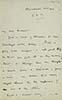
Permanent Mission of India to the United Nations, 3 East 64th Street, New York.—Agrees with his views regarding the actions of the British Government in the Middle East, and shares his concern for Indo-British relations. Discusses the current situation in Egypt.
—————
Transcript
Permanent Mission of India to the United Nations,
3 East 64th Street, New York 21, N.Y.
17 November 1956
My dear Lord Pethwick† Lawrence,
Thank you for your letter. It was kind of you to have written to me. I had no doubt at all about your position or indeed of any responsible sane person in England! I share your apprehensions about Indo-British relations. There is much pressure in India in regard to this but I think and hope we will behave with a sense of maturity and proportion. I have fear, however, that if the U.K. pursues its predatory policy and finds a pretext for waging more war or pursuing expansionism perhaps using the Russian menace as an excuse we shall have serious difficulty.
The situation in regard to Egypt is anything but satisfactory. The reports we have of atrocities and the nature of the campaign waged there are shocking. It is inconceivable to us that in the present age that† British or their Commanders would behave in this way. I understand that Mr Gaitskell has been sent some information from independent sources by eye witnesses. As you probably know, journalists are not allowed into this area and our report, which I do not wish to be quoted, is that some of them have been arrested and detained for short periods. These are European journalists.
However, in regard to British policy, there is appreciation in India that the U.K. is very divided on this matter, and while there was much regret in the initial position of the Labour Party in August, there is understanding now that this is a fanatical approach to a difficult problem by the present Government and leaders. The next phase of this, if it is not renewal of war, would be an attempt to use the present crisis and the fact that the Middle East affairs† is before the United Nations, to attain through the U.N. and the U.S. the control of the Suez Canal under the guise of international organization. This issue of course is part of the general problem of internationalisation of waterways to which we all subscribe.
I am personally very apprehensive for all that goes on and whether it will be in regard to the Middle East or Hungary events can drift to a situation of world war.
On the topic that you have kindly written to me, namely, Indo-British relations, there is at present no danger of precipitate action. But I can envisage a situation where nothing else becomes possible say in the case of Britain being involved in a prolonged war.
Kind regards
Yours ever
Krishna
Lord Pethwick† Lawrence,
11 Old Square,
London, W.C.2. England.
—————
Marked by a secretary, ‘Let P-L ack: receipt of this letter on his Xmas card to Menon. 22/11/56.’
† Sic.
PETH/7/100
·
Pièce
·
17 June 1901
Fait partie de Pethick-Lawrence Papers
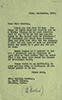
Broadmoor Cottages (near Dorking).—Thanks him for his letter, and refers to today’s activities.
PETH/1/100
·
Pièce
·
22 Sept. 1954
Fait partie de Pethick-Lawrence Papers
Discusses dates when they might meet for lunch at the House of Lords, and offers to show her round the Houses of Parliament first.
Add. MS a/206/100
·
Pièce
·
[1 Apr. 1848?]
Fait partie de Additional Manuscripts a
Trinity College - HAH returns to WW the proof sheet: 'The corrections I have noted on the margin refer principally to errors of the press'.
Add. MS a/80/100
·
Pièce
·
31 Aug. 1854
Fait partie de Additional Manuscripts a
Add. MS a/244/100
·
Pièce
·
[19th cent.]
Fait partie de Additional Manuscripts a
thanks him for his equestrian sketch, the portrait of Trench and the Discourse
Add. MS a/215/100
·
Pièce
·
28 Oct. 1848
Fait partie de Additional Manuscripts a
If Ma-Man is still with JCH on the 6th, WW will try to come to them for a day. He gave Mrs Augustus Hare a copy of his short critique of Hegel's vagaries to pass to JCH [On Hegel's Criticism of Newton's Principia, 1849]: 'There is nothing which so entirely deprives men of all respect for German heads in the matter of reasoning as the way in which they have allowed Hegel to dominate over them. It appears to me that on every subject he is equally fanciful and shallow though he may not be so demonstratively wrong as in the matter of Newton. Sedgwick [Adam Sedgwick] is mightily delighted and entertained with my paper'.
Add. MS c/100/100
·
Pièce
·
12 Feb. 1884
Fait partie de Additional Manuscripts c
Refers to [W.F.] Barrett's letter as 'a bore'. States that they must 'maintain the distinction between experimental work and collection of narratives, and between hypnotic and normal state'. Suggests that they appease Barrett by admitting 'the great advantage of having all the evidence set forth together from time to time by an able hand' and allow him to print his paper, provided it is not called a 'Report of the [ ] [ ] Committee.' States that he is writing to Gurney with this proposal. Adds that he intends to propose the Lord Rayleigh F.R.S. as Vice-President [of the Society for Psychical Research] at their next council meeting.
Add. MS c/93/100
·
Pièce
·
13 Aug. 1898
Fait partie de Additional Manuscripts c
Informs Sidgwick that the holidays have given him time to read the E[ncyclopedia Britannica?], which he had sent to him. Remarks that his analysis of 'Public Morality' 'clears up several matters'. Discusses the principles on which a historian ought to judge the actions of a statesman, claims that Acton 'does not face the difference...between the principles on which a statesman may act and those aforementioned historian's principles', and warns against the critic introducing his own presuppositions. Remarks that Sidgwick had not touched on the moral influence on the historian's generation of a public war, and uses Bismarck to illustrate his point. Agrees with Sidgwick about 'clerical veracity', and remarks that it is 'curious how the moral sense of the community has practically ruled out Rashdall's view.' States that he is enjoying 'this place' very much.
Add. MS a/79/100
·
Pièce
·
10 Oct. 1859
Fait partie de Additional Manuscripts a
HOUG/32/100
·
Pièce
·
17 Jun. [1800s]
Fait partie de Papers of Richard Monckton Milnes, Lord Houghton
HOUG/36/100
·
Pièce
·
[1840 or later]
Fait partie de Papers of Richard Monckton Milnes, Lord Houghton
Downing Street. - Encloses Lord Melville's reply [no longer present]; no hope of Vansittart as Chancellor of the Exchequer, will offer position to Robert Pemberton Milnes who could be of great service.
Also contains notes on the life of Lady Crewe copied from the autobiography of Hester Piozzi, including origin of the bluestocking assemblies.
Copy in unidentified hand; paper watermarked 1840.
TREJ/35/100
·
Pièce
·
[n.d.]
Fait partie de Papers of Julian Trevelyan
HOUG/CB/100
·
Dossier
·
[Jul. 1839?]-[1840s?]
Fait partie de Papers of Richard Monckton Milnes, Lord Houghton
THMG/E/100
·
Dossier
·
1961
Fait partie de Papers of Sir George Paget Thomson
32nd Meeting
Agenda, Minutes.
Meeting No.33, 12 June 1961.
Agenda, Minutes.
Meeting No.34, 12 October 1961.
Agenda, 8 pp. duplicated typescript re `A.E.I. Plasma Research Programme', Minutes.
THMG/G/100
·
Dossier
·
1969
Fait partie de Papers of Sir George Paget Thomson
FRSH/C/100
·
Dossier
·
1977–1978
Fait partie de Papers of Otto Frisch
FRSH/A/100
·
Dossier
·
n.d.
Fait partie de Papers of Otto Frisch
SYNG/E/100
·
Dossier
·
n.d.
Fait partie de Papers of Richard Synge
Contents of Synge's envelope so inscribed: photographic data from samples; manuscript table.