
Delivered to the Literary Society, 15 Oct. 1881, enclosing 4 diagrams.
'Muirhead Bone - To A. S. F. Gow with kind regards'.
Office of the Director, Folger Shakespeare Library, Washington.—Praises The Editorial Problem in Shakespeare and discusses the progress of the Folger Library.
—————
Transcript
The Folger Shakespeare Library, Washington
Office of the Director
December 29, 1942.
Dear Doctor Greg:
The copy of your “The Editorial Problem in Shakespeare,” came just in time to be a most delightful Christmas gift, and its reading made the holiday season for me very pleasant indeed. I admire, more than I can tell you, the cautious, judicial attitude you everywhere maintain, and the nicety of expression by which you achieve clarity in presenting the most difficult material. The volume will be an absolutely indispensable reference work for all editors of Shakespeare, and a guide in all future research into the origin and nature of the copy lying behind the printed texts of plays. And what a problem that is! I confess that some of the theories tentatively devised to explain the preparation of printer’s copy seem to me too complicated for a procedure that must have been simple and natural. But your clear presentation of the facts and summary of theories will inspire Shakespeare scholars to further efforts. I myself feel an “itch” to get at several of the problems, even though I realize that, except by chance, I would probably have no success. Please accept my deepest gratitude, which I know is shared by all students of Shakespeare, for your inspiring work.
The Folger Library continues to grow by leaps and bounds. To that cause I am devoting all my time and energy, for I believe that Shakespeare is the strongest and most lasting link to unite England and America, and that the preservation of that union, political and cultural, is the most important need of the world. I like to think that for centuries to come, young Americans will be flocking to the Folger to study the literature which is both the common product, and the heritage, of our two peoples. And if I can accomplish something towards promoting that end, I am content to sacrifice in part my productivity in research.
The progress of the war is a matter of keen satisfaction, and we are now hoping that by the fall we can again have our books back in the stacks and vaults, and our Reading Room crowded with workers.
With thanks for the thoughtful gift of your latest book, and best wishes for a happy and prosperous new year, I am,
Ever yours,
Joseph Q. Adams
Dr. W. W. Greg,
Standlands, River, Petworth, Sussex, England.
JQA:mp
—————
Typed, except the signature.
Sent from Catshill, near Bromsgrove. - Card labelled 'The Clock House - In aid of the Church Funds' [The Clock House, also known as Fockbury House, was a childhood home of A. E. Housman].
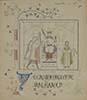
Two drawings, "Ye crowning of ye Jarl Harold" showing Harold's coronation as depicted in the Bayeux Tapestry, and an illuminated manuscript page of the beginning of the Ten Commandments. Accompanied by an envelope which identifies these as illuminations done in childhood.
A journal recording his work as Master of Trinity College, with notes on letters sent and received and in addition, drafts of 74 letters, listed separately according to the page number of the journal on which each letter begins. An index in the hand of Janet Douglas is tipped in at front.
Thanks her for her letter. Is unable to express her own happiness, and how much she wishes to be a good wife to Henry and a good daughter to her; looks forward to getting to know her.
Zonder titelOn books recommended for reading in relation to medieval ethics, including Gass' Geschichte der Christlichen Ethik, a volume of lectures by Neander, and Bettmann's Geschichte der Christichen Seite. Gives opinion as to the merits of each. Recommends especially Histoire des auteurs ecclesiastiques in 22 vols. by Ceillier, and 'the new edition' of Havreau. Mentions also Winter's book on the Ethics of the School of Alexandria and Jourdain's book on St Thomas. In relation to Hartmann's Phenomenology, claims it to be 'rude and spare' in the treatment of medieval theory, and comments that Sidgwick's 'enemy' Guyau 'knows nothing about it.' Mentions that his inability to verify the titles of his suggestions is due to the fact that he is ill in bed at the time of writing
About an [insurance?] policy.
Zonder titelReports that he made the enquiry of which they spoke 'from the [ ] of the Colonial Office respecting Government by Companies', and encloses his reply [not included], which reached him on the day on which he writes. Remarks it to be 'a curious thing that after [England] has, as many thought entirely shaken itself clear of this form of dual [Govt.] after the E[ast] I[ndia] Co. had been made an end of - that it should have slid back again into this old [favour] and sanctioned the establishment of so many new companies of the old plan.' Asks Sidgwick to return the 'Gazette copy of the [ ] [Borneo] [Charter]' and Meade's letter when he has finished with them. States that he has written to thank the latter. Asks Sidgwick to write a short article 'on the subject' for his Dictionary [of Political Economy]. Claims that when he has had to write on any special subject that 'requires care', he has never minded writing a short article on it first, 'as the doing so seems to help to clear one's mind'. Refers to his meeting with Sidgwick in Cambridge, and invites him and Mrs Sidgwick to visit himself and his wife during the summer.