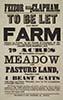
(The review is headed, ‘Mr Housman’s Farewell. A Last Book of Poems. The Epithalamium’.)
17 North Road, Highgate, N.—Discusses family finances.
(Black-edged paper.)
—————
Transcript
17 North Road | Highgate N.
19 June 1905.
My dear Clemence,
I enclose:—
A letter from Basil,
Kate’s letter to you,
Two letters from A. Parker to Laurence.
I will fall in with either Kate’s scheme or Basil’s, if the rest of you can agree on either. For my own part I should prefer to do as A. Parker suggests, and let things continue on as at present till Aunt Kate’s death or at anyrate till the £150 in hand is exhausted. When either of those events arrives, it is to be hoped and expected that we shall all be either dead or richer than now. But I will not oppose any solution which finds favour with the rest of you; and I can quite well pay either £93.15.0 or £125; only, as I have just spent £70 on my new book (a sum which the sale of the whole edition will not bring in), and may want to spend another similar sum before two years are out, and am contributing by instalments of £20 a special subscription of £100 to the College, and have indulged in the luxury of an assistant, who costs £50, and have been rather extravagant in the matter of foreign travel,—it would reduce my balance at the bankers below the comfortable margin which would enable me to flee to the continent at any moment with a year’s income in my pockets, or lend a hundred or two at a moment’s notice to a friend who might want it. I don’t know whether the way Basil proposes to dispose of your money has your sanction.
Your affectionate brother
A. E. Housman.
8 Macpherson Avenue, Toronto, Canada.—Asks for a specimen of the Society’s book-plate, and sends two of his own design.
(The design at the head of the paper is similar to Add. MS a. 684/1/2. The Bibliographical Society did not have a Librarian; the letter was presumably passed to R. B. McKerrow as Secretary.)
—————
Transcript
83 Macpherson Avenue, Toronto, Canada
2nd November 1918
Mr Stanley Harrod presents his compliments to the Librarian of the Bibliographical Society and begs to request that he may be favoured with one of the society’s bookplates by C. W. Sherborn.
He wishes to explain that in taking this somewhat presumptuous step he is actuated solely by a desire to possess examples of the highest attainment in this field of art, that by their study he may improve his own work. To accomplish this end he must appeal to the courtesy and generosity of the owners of the plates.
He encloses two of his own designs in the hope that they may prove of some slight interest.
Entitled "List of Portraits of Trinity Men in the College Library" giving the size of the plate, the size of the paper, the painter's name and/or the engraver's name, with annotations by Lord Adrian recording additions to the list and presence of some of the works in the Combination Room.
Duplicated typescript, corrected, with four duplicated maps. A reconstruction of the fields of Grantchester as they were before enclosure.
Saltmarsh, John (1908-1974) historianTrinity College - unable to accept an introduction to [William?] Wordsworth, use of βεβαιοσ
Regrets he cannot dine in College, must go North to be with Isabella, who is seriously ill.
Sedgwick, Adam (1785-1873), geologistC/o Miss (Mary A.) Hollingworth, Leithen, Newnham Road, Bedford.—Asks him to write a testimonial to the Pitt Press in support of her system of ‘orthotype’ (‘a method of Printing Reform versus Spelling Reform’), and encloses related papers.
(With envelope. Undated. Postmarked 20 Nov. 1909.)
—————
Transcript
c/o of† Miss Hollingworth
Leithen, Newnham Road, Bedford
Dear Mr Wright,
The Pitt Press staff are now deciding whether they will publish my Orthotype Method or no. You will remember I asked your advice about it when we were staying at Dr Ginsburg’s. It is a method of Printing Reform versus Spelling Reform intended to save our international words such as “nation” “philosopher” {1} etc. from destruction at the hands of the Spelling Reformers. It is evident that if they succeed there will be no longer any English Language,—but an American, Anglo-Indian, Anglo-Chinese, Scotch, Irish, South British, {2} North British or Anglo-African—language etc. in these several countries. i.e. Our Empire will have no common language.
Could you send me a testimonial to the effect that you disapprove of the method of sacrificing what is permanent & international i e the spelling, to that which is local & transitory i.e. the sound, & that if a phonetic key is necessary for students & teachers you prefer Orthotype which does not alter the spelling. I enclose you a copy of a letter just received from W. St Clair Tisdall D.D. who is a well-known Orientalist & reputed to know 40 languages. You will see that he considers Orthotype indispensable.
I should be very grateful for a quick reply to the Pitt Press (the secretary has my manuscript) or to myself.
With very kind regards | Believe me
Yours sincerely
Anne Deane Butcher
[Direction on envelope:] Wm Aldis Wright Esq. L.L.D. | Trinity College | Cambridge
—————
The envelope was postmarked at Bedford on 20 November 1909.
{1} Opening inverted commas supplied.
{2} Comma supplied.
† Sic.

Royal Hotel, Blackfriars.—Intends to visit him at Trinity College, Cambridge, on Good Friday.
(The initial greeting is ‘My dear Sir’.)
—————
Transcript
Royal Hotel, Blackfriars.
9 April 1873.
My dear Sir,
You will, I trust, by this have learnt out of a letter of our friend Furnivall, that I intend to pay you a visit on Good Friday {1}. As my present stay in England is so very limited and as I must be back to my academical duties at the 17th., it is impossible for me to defer my trip to Cambridge untill† next week. My leisure is indeed so fully occupied that I must return to London on Good Friday night. But my chief object is to see you and I hope you will manage to bestow on me as much as you can of your time for the course of Friday. Mr. Furnivall told me of a train leaving Kings Cross at nine o’clock in the morning, and I shall take that. Of course, on my arrival I shall immediately proceed to Trinity College, so you must not take the trouble of coming to the Railway Station. Yours, very faithfully
N. Delius.
—————
{1} 11 April.
† Sic.
(With a photocopy of an envelope.)
—————
Transcript
Trinity College | Cambridge
17 Dec. 1926
My dear Gerald,
I have got your letter of Oct. 11 and am glad to hear of your doings, but the earlier letter which you speak of did not find its way to me. I expect it was eaten by a lion, as you may have been by this time.
If I remember right, you were here in May just before I went off to Venice to see my gondolier. I found him better than I expected, as hot weather suits him, and he is still alive, but he’s just gone into hospital with hemorrhage. I stayed there only a few days, and then spent a week or so in Paris. In July and August I was at my old home and other haunts of childhood in Worcestershire and Gloucestershire. At Woodchester, once my grandfather’s parish, there is a Roman pavement, the finest in England, which is uncovered and shown from time to time, and this year was one of those occasions: I spent a week in the place, which I should have enjoyed more if I had not been dragged in to make explanatory speeches to the visitors, owing to the lack of persons in the village who could do it. Then I made a short motoring tour in Derbyshire, to see the most picturesque spots.
I heard from your mother not long ago, but I need not tell you any of her news. I am glad that Africa is geologically a good continent, and I hope its Christmas weather is not too hot.
Your affectionate godfather
A. E. Housman.
[Direction on envelope:] Gerald Jackson Esq. | R.C.B.C. Ltd. | N’Changa | Via N’Dola | N. Rhodesia | S. Africa
—————
The envelope, which has been marked ‘Answered 24/3/27’, was postmarked at Cambridge at 10.45 p.m.(?) on 17 December. The postage stamp has been torn off.
(Place of writing not indicated.)—‘McKerrow’s book is awfully good, really.’
She and her family 'always considered Mr Sidgwick, when [they] were all young together, as the most lively, interested talker' they knew. Remembers a visit he made to them as an undergraduate [in 1858], when he stayed some time, 'joined in everything the family did, and... made everything he joined in more amusing'. He suggested they 'should get up Tableau vivants'', proposing 'Sleeping Beauty' for her, and saying that Miss Tawney - her sister-in-law - 'would do excellently for the beauty.'
Relates another incident during the same visit in which she went to the drawing room to help her mother receive some callers 'and saw at the other end of the room Mr. Sidgwick asleep in an easy chair, dressed in an Afghan costume of white felt belonging to [her] father, and wearing the fur cap belonging to it', with a sleeping kitten asleep on top. Declares that he was such a charming visitor, 'always amusing and always making himself at home with [them].'
Latham, Marianne Frances (1839-1926) née Bernard, mistress of GirtonInstructions for the moves involved in various dances. Accompanied by envelope, inscribed 'Rules for Dancing HS.'
Sidgwick, Henry (1838-1900), philosopherRe children of the poet Robert Bloomfield.