
HOUG/39/120
·
Item
Part of Papers of Richard Monckton Milnes, Lord Houghton
3351 results with digital objects
Show results with digital objects
FRSH/B/120
·
File
·
1940–1942
Part of Papers of Otto Frisch
Johnson, C.H. 1940, 1943 (Frisch's carbon only)
Kinsey, B.B. 1942
TAYL/A/120
·
File
·
1929–34
Part of Papers of Sir Geoffrey Taylor (G. I. Taylor)
Many of these are annotated by her, or bear a note `answered', in the manner of Taylor who may have acquired it from his mother.
ADMS/B/120
·
File
Part of Papers of Frank Adams
DAVT/A/120
·
Item
·
1960–61
Part of Papers of Harold Davenport
SYNG/J/120
·
File
·
1951-1965
Part of Papers of Richard Synge
Correspondence re visits of Halse to the Rowett Research Institute and of Synge to Norway, 1951-1956, 1960-1961, 1965.
Halse was based in the Physiology Department of the Veterinary College of Norway, Oslo, Norway.
THMG/E/120
·
File
·
c 1955
Part of Papers of Sir George Paget Thomson
Accompanied by letter from Sturrock to Thomson, 31 January 1955, and 1 p. ms. notes by Thomson.
THMG/J/120
·
File
·
1930-55
Part of Papers of Sir George Paget Thomson
Some correspondence arising from Thomson's book 'The Foreseeable Future'. 1955
FRAZ/2/120
·
Item
·
30 Oct. 1932
Part of Papers of Sir James Frazer
Grangegorman, Overstrand, Cromer - Asks about the existence of a sense of humour in primitive races.
FRAZ/3/120
·
Item
·
10 Oct. 1913
Part of Papers of Sir James Frazer
Park View Hotel, Hyde Park Corner, London, S.W. - Has returned to London, will soon be in a house, the book ['The Hapsburg Monarchy'], is due out next week, he will give the first one to J. G.; encloses a review of one of Frazer's books in the 'Débats' [not present].
FRAZ/18/120
·
Item
·
16 Nov. [1903?]
Part of Papers of Sir James Frazer
27 Queen's Gate Gardens, S.W. - Thanks her for Frazer's portrait, and for the luncheon party; found it characteristic of Frazer that it was held to help a fellow student.
TRER/8/120
·
Item
·
24 July 1939
Part of TEST
93, High Street, Knaphill, Woking. - Hears from John [Wellcome Tovey] that they are bringing an Austrian doctor [Karl Bluth, who was in fact German] to see Donald [Tovey] at Hedenham and therefore his own doctor 'an old and very distinguished man who loves him' has been sent back, having already started from Edinburgh . Will say nothing about that, nor will Dr [Robert?] Thin; 'daresay he knows Lady Tovey'. She herself has 'the most enormous respect for the Viennese medical school' and would welcome this doctor's examination of Donald as long as he 'knew all the circumstances': that until his second marriage he had never once failed to keep a musical engagement, but since then he has been 'constantly ill - chiefly in that damp hole Hedenham'. He has now lost the use of his hands [through arthritis]; she heard nothing of this until she came to Edinburgh in December and 'was stricken to the heart when he showed them' to her; always used to say that 'if Donald's hands were injured his brain would be affected', and now, 'among the meagre news of him doled out' to her she hears his brain is 'failing'. As recently as 'this last January' Lady Tovey and Miss Morah were saying 'it was just laziness if he did not practice'. Would be very grateful if Trevelyan could bring the Austrian doctor to see her here: 'Jew or Gentile' she would be 'full of respect' if he is what she knows Viennese doctors to be. She is not far away; describes the location of her 'little house'.
TRER/2/120
·
Item
·
15 May [1922]
Part of TEST
Enjoyed his week with the Trevelyans, as ever, in their 'little paradise of rhododendrons Chess and Tchehov'. Has also just had a pleasant weekend in Hertfordshire. Leaves tomorrow for Lyme Regis.
TRER/4/120
·
Item
·
27 Aug 1943
Part of TEST
Lt. J. M. Luce c/o Grindlay's Bank, Bombay. - The journey out took about two months and was uneventful. Has found India 'very disappointing' so far: is staying in an isolated depot at some distance from Calcutta for a couple of months, before being posted to either an English regiment, which would probably mean the Burma front, or an Indian regiment for training. Gives his impressions in some detail, mentioning the people, the countryside, and the jackals (a menace at night, since they live in open tents). Has met 'one charming Indian', the local contractor, who reads English philosophy and possesses a copy of Forster's "Passage to India" though does not seem entirely to approve of it. Notable how disillusioned his whole party 'of typical middle-class Englishmen' were by their first contact with India.
TRER/16/120
·
Item
·
21 June 1930
Part of TEST
28, Rue de la Tourelle, Boulougne sur Seine. - Much regrets not being able to visit the Shiffolds and meet Mrs Trevelyan; was looking forward to it very much; thanks her for her invitation. Would have liked to talk to Mr Trevelyan and read their 'beloved tragedies' together. Begs Mrs Trevelyan to come to Paris and visit them; Reksucha [the dog] would be 'happy indeed'.
TRER/14/120
·
Item
·
9 Sept 1931
Part of TEST
Hallington Hall, Newcastle-on-Tyne. - Has received a letter from Withers saying that Bob will pay George 1500 francs, which will be 'very useful'; this is a 'very pleasant after-math to the whole of our family business' beginning four years ago [on the death of Florence Trevelyan's husband Salvatore Cacciola]. Has just finished writing a memoir on their father, which he plans to publish 'next spring unless the country has been ruined'; has had copies made and will give them to his brothers; suggests possible weekends for Bob to come to Cambridge, or for George himself to visit the Shiffolds, to discuss it.
TRER/22/120
·
Item
·
13 Jan 1947
Part of TEST
Ashmansworth, nr Newbury, Berks. - Has left till last his thanks for the 'one or two good things' sent at Christmas, and wants Trevelyan to know 'how much [he] appreciated' the 1946 "From the Shiffolds", which he will keep with the two collected volumes and everything else which has come out since then. Imagines that by now Trevelyan has 'more than enough to fill the two volumes of translations which will originally promised', and that these will come out in good time. Also hopes the collected works will be 'revived', with the additions of 'the good things that came afterwards'. Regrets that 'Composers are at a disadvantage' since any music they sent would be 'little more than hieroglyphics to all but a few'. Perhaps, on the contrary, 'the poet is at a disadvantage in knowing less about music than the musician knows about poetry!'. Asks 'boldly' to be remembered again in 1947.
SMIJ/1/120
·
Item
·
[c. July 1938]
Part of Papers of James Smith
110 Banbury Road, Oxford.—The enclosed letter from Deighton Bell may explain why Smith has not received a copy of Scrutiny. Thanks him for his notes on [Enea] Vico, and refers to Vico’s Vetustissima Tabula. Is thinking of coming over towards the end of the vacation. Is sick of reading books he hasn’t read before, like De Nolhac’s Pétrarque et l'Humanisme. Cites a quotation to encourage Smith in his gardening.
PETH/2/120
·
Item
·
29 Nov. 1957
Part of Pethick-Lawrence Papers
MONT II/B/1/120
·
Item
·
2 June 1915
Part of Papers of Edwin Montagu, Part II
BUTJ/A/1/120
·
Item
·
19 Jan 1923
Part of Papers of Sir James Butler (J. R. M. Butler)
Buckingham Palace. Thanks for congratulations on his engagement.
SHAF/B/10/1/120
·
Item
·
27 Nov. 1974
Part of Papers of Sir Peter Shaffer
BACH/F/3/120
·
File
·
19 Dec 1974
Part of Papers of G. K. Batchelor
PETH/8/120
·
Item
·
10 Oct. 1916
Part of Pethick-Lawrence Papers
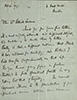
10 Broad Walk, Buxton.—Comments on the presentation of spiritual union between men and women in fiction.
—————
Transcript
10. Broad Walk | Buxton
Oct 10. 1917.
Dear Mrs. Pethick Lawrence
Thank you for your fine letter. It’s a most awfully intricate and difficult subject, and maddening to make clear by letter. Poetry is such a different medium that I think it does not serve for analogy; and Rolland I don’t care for (unfashionable as that is). Do you know of any figure in fiction stretched to full spiritual growth, in any setting but that of tragedy. The nearest approach I know to the presentation of full spiritual union between man & woman in real art is Pierre & Natasha in Tolstoi’s War & Peace; and how very flat the ending of that great book is! The same may be said of Levin & Kitty in ‘Anna Karenin’! {1}
Henry James tried it in ‘A Portrait of a Lady’ but he left an ending which may be read either way; &, whichever way you read, it tells us nothing. Full spiritual development in happiness seems fated to be anti-climaxic, I suppose because it means Nirvana of which nothing can be said.
Some day we’ll talk about it perhaps.
Yours very sincerely
John Galsworthy
—————
{1} Closing inverted comma supplied.
SMIH/91/120
·
Item
·
20 Nov. 1911
Part of Papers of Sir Henry Babington Smith
O./15.47/120
·
Item
·
[c 1872]
Part of Manuscripts in Wren Class O
Add. MS c/88/120
·
Item
·
31 Aug. 1842
Part of Additional Manuscripts c
Add. MS a/200/120
·
Item
·
5 Nov. 1857
Part of Additional Manuscripts a
Royal Observatory Greenwich - As far as GA remembers, WW quoted accurately from him concerning the old eclipses: 'and I was certainly correct: the only point on which change could be suspected (a point of no interest to the chronology) being that in the first paper I had left open the passage of Agathocles to the North or South of Sicily, inclining however to the North, but in the second paper I decide on the South'. There was some quibbling about another eclipse 'computed only from [Buachkardt's] elements, and is so stated in my first paper. It has since been computed with Hansen's elements (nearly as was described for Buackhardt's) far north of the sea of Azores. If this is the matter of which you were thinking I will send a note on it to the Athenaeum'. Were the quarrels at the BAAS meeting of 1857 or 1856?.
Add. MS a/208/120
·
Item
·
24 Mar. 1832
Part of Additional Manuscripts a
London - CL has just received a letter from Scrope [George Poulett Scrope] giving his opinion of CL's 'Principles of Geology', volume 2 and the review of it in the Quarterly Review [WW, Review of 'Lyell's 'Principles of Geology', volume 2', Quarterly Review, 1832]: 'Scrope is regarded by Lockhart, Murray and Co. as a first rate reviewer an opinion in which I fully coincide'. He thought the review was good and fair, and thought it by either Fitton [William Henry Fitton] or Greenough [George Bellas Greenough]. The most common complaint against CL's book is that the most original part - the extinction of species - is the least dwelt upon.