Showing 62708 results

Archival description
3351 results with digital objects Show results with digital objects
TRER/23/9 · Item · 29 Jul 1918
Part of TEST

5 Paper Buildings, Temple, E.C.4. - The appeal of N.S.R. [the National Service Representative] against Trevelyan from the Dorking Local Tribunal was heard at Guildford on 27 July 1918. It was decided by the Appeal Tribunal that Trevelyan should have exemption from military service conditional on him remaining employed with the Relief Committee of the Society of Friends.

TRER/23/121/9 · Part · 1800s?
Part of TEST

Account of mistake made by Mr [Barwell?] Ewins Bennett at a party given by Mark Philips during the assize week at Warwick: having drunk 'freely' of the 'wonderful sherry', he called it on leaving 'that excellent Marsala'. Also a comic poem about the occasion composed by a 'wag in court' when asked 'how many rhymes he could make to Marsala in 10 minutes'.

TRER/45/9 · Item · [c 1882]
Part of TEST

Decorated with transfer sticker of a sailing ship. Hopes his family are well and happy, as he is. There is a 'rage for Stilographic and Antistilographic [sic] pens'. Hugo has not been expelled. Will be 'very glad' to have a few photographs. Is 'top for the week in Latin'. The exams are this week. Asks his mother to send some stamps, envelopes and note paper. Mrs Arnold gives lectures on botany. Has begun to collect stamps; Smith has given him 21, Browning 7, and Smith is going to give him some more; knows she does not mind. Glad to hear Grandpapa [Trevelyan?] Is better. Robert and Charlie have been writing postcards to each other ‘in the secret way’. Adds a postscript hoping that Sophy is all right.

TRER/22/9 · Item · 15 Dec 1948
Part of TEST

Horn Hill Court, Chalfont St. Peter, Bucks. - Thanks Trevelyan for "From the Shiffolds": has reread his 'beautiful poem' to [Goldsworthy] Lowes Dickinson. Is sure the 'wisdom' and 'light of the spirit' does not 'go out' at death, and this 'world of beautiful spirits' 'may be very near' the living, part of the 'mystery of life' which man may 'fathom one day. Nobody knew about 'ether waves a hundred years ago' though they were 'always there'. Or, as Trevelyan says, it might be that 'words & deeds' will not die, but continue to work in secret in 'the hearts of men unborn' (to quote his poem to Marjory Allen). However, she thinks she has felt goodness and evil 'emanating' from people, signifying 'some unmaterial power' in the world. Discusses memory and capturing of moments in poetry. Trevelyan's poetry always brings her 'tranquillity'. Adds a postscript to say she is enclosing a poem she wrote 'many years ago', which she fears is 'very imperfect'.

Separate sheet with Roscoe's poem "The Giant Buddha (At the Chinese Exhibition)"

TRER/13/9 · Item · 5 Sept 1898
Part of TEST

12 Pembroke Gardens, Kensington, W. - Saw Helen yesterday and today; took her Bob's book ["Mallow and Asphodel"], in which 'I forged yr. initials & her name in yr. handwriting', thinking this would make it 'more valuable to her'. Upset at first to find how ill she was, and 'how hopeless it seemed to arrive at her real self at all', but spent several hours with her; Edith Coombe [Helen's sister] was there throughout. Towards the end Helen woke up, asked questions about her friends and the harpsichord [which she is decorating for Dolmetsch] and seemed much pleased by the book, responding to Fry's prompts about Bob's reading to them at Taormina; also discussed a picture by Fry hanging in her room. This was all an improvement and 'quite astonished Dr Chambers'; she was quieter today but seemed easier with him; hopes he will be able to do her some good and will visit every day unless it excites her too much; very hard to 'keep up a one sided conversation for 3 hrs' and feels quite drained at the end. Asks Bob to help by writing to Helen, talking of 'simple things & yr. fondness for her - everything which gives her an idea of her own importance & helpfulness to others is good', and by giving Fry 'interesting & amusing things about people & books' to talk about with her. Is finding his writing very hard, since Helen 'seems all important' and he cannot bring himself to care 'a tuppenny damn' about 'the date of Bissolo's death', but it is a good distraction. Knows Bob will help.

MONT II/A/3/26/9 · Item · 12 Jan. 1922
Part of Papers of Edwin Montagu, Part II

They do not know what Gandhi intends to do at the Conference at Bombay. If he adopts the same position he put forward at Congress meetings they will not have advanced, though it is possible that some influential people will stand against him; on the other hand, it will also hinder their plans if he compromises with some of the moderates. However, Reading does not think he will moderate his demands, as he has committed himself to them too publicly and is obsessed with the notion that he can paralyse Government. The crowding of jails has created numerous problems, and Reading hopes the desire to court arrest will abate. The Budget may cause serious trouble, since the impending rise in taxation will lead to resentment of the presence of British troops, which represent a large proportion of expenditure.

MCKW/A/2/9 · Item · 7 Feb. 1911
Part of Papers of R. B. McKerrow

(Sheffield.)—Thanks him for his help with an article on Harvey. Adds further notes on Nashe and brief comments on other subjects.

(With an envelope, postmarked at Sheffield.)

—————

Transcript

7 Feb

Dear McKerrow,

It was very good of you to look at G. Harvey {1} again. I hope you did not go on purpose,—I am so sorry I did not tell you of all my wants at once.

Your corrections are in good time, as I have not received a proof of my N & Q paper. I am sorry to hear of your cold. & hope you are now all right.

Do vote for Cox. {2}

I have got ‘Grace Book Δ’ (a reviewer’s copy) just edited by Venn. It contains all degrees 1542–1589 & other University records. It will be a valuable book of reference—& save one from writing to the Registrary.

I have been reading part of Nashe again in connexion with my paper on Harvey—& send you a few notes on your notes. {3} (I am afraid, rather useless now)

Vol IV

p 154 l 8 for Erogonist, Ergonist

p 156 l 11 fr. bot. Was the Barnard so called from the proverb ‘Bernardus non vidit omnia’?

p 159 n. on 262. 5. Does not ‘book-beare’ mean ‘lectern’?

p 160 n. on 265. 28 Did Barnes write ‘Meg a Court’?

n. on 267 2,3. I suppose Nashe is parodying—‘Here beginneth the first Epistle to the Philippians &c’—but the expression is a clumsy joke if so

p 176 n. on 294. 23. I suppose you take Pistlepregmos as = dealer in Pistles, or Epistles.

p 181 n on 302 13. The louse had 6 feet I suppose like Harvey’s hexameters

p 182 n. on 305 24. Sailors, I am told still divide foreigners into ‘Dutchmen’ (Germans, Scandinavians &c) & ‘Dago’s’ (French, Spaniards &c)

p 183 n. on 305. 22. {4} I suppose Harvey is translating Summa Summarum.

p 189 n. on 313 23. ‘Matthew’ should be ‘Nathanael’—according to the Admissions to Fellowships in S. John’s Coll.

p 191. n. on 322. 31. Is this a certain explanation? Is there other ground for thinking that Nashe’s Lord was a Dudley?

316. n. on 29. 21. Is this to {5} Tho. Freigius? I dont know if he wrote a Paedagogus.

339 n. on 74. 18. Doctor Hum. Does not this refer to the Cambridge use of ‘hum’ as a sign of disapproval? [? scraping the feet—or making a noise with the voice] {6} Cp. Mead’s letter to Stuteville 27 June 1623 (Heywood & Wright’s Camb. University Transactions 315) ‘Mr Lucy ‥ was this week created Doctor ‥ with such distast of the regents that they hummed when he came in.’ {8}

n. on 76. 35. Is not Sir Edw. Dyer more likely? He was a Knight before Greville—but I dont know the dates

359 n. on 114. 16. Tennyson uses it in The Grandmother I think.

365. n. on 126. 31,2 See Pedantius l 194. {9}

Ever yours
G. C. Moore Smith

I am glad to hear your patient has got to Canada.

[Added on the back of the envelope:] Secker is going to print Tubbe. {10}

[Direction on envelope:] R. B. McKerrow Esq | 4 Phœnix Lodge Mansions | Brook Green | Hammersmith | London W

—————

The envelope, which has been marked ‘Notes on Nashe’, was postmarked at Sheffield S.D.S.O. at 1 p.m. on 7 February 1911, and at Paddington, W, at 7.15 p.m. the same day.

{1} Gabriel Harvey’s letter-book, in the British Library (MS. Sloane 93). Moore Smith’s paper ‘Gabriel Harvey’s Letter-Book’, which appeared in Notes and Queries on 3 April (11th series, iii. 261–3), included a number of corrections to the edition of the letter-book prepared for the Camden Society by E. J. L. Scott in 1884, prefaced by the following acknowledgement: ‘For some of the corrections below I am indebted to Mr. R. B. McKerrow, who was kind enough to look at the MS. for me after I had left London.’ The corrections supplied by McKerrow are dis-tinguished in the article by asterisks.

{2} Harold Cox, the Liberal candidate for the constituency of Cambridge University in the by-election held in this year.

{3} The succeeding notes relate to Nashe’s Strange Newes and Have With You to Saffron-Walden.

{4} ‘22’ is a mistake for ‘32’.

{5} Reading uncertain.

{6} The opening square bracket is original; the closing one has been substituted for a round one.

{7} Single inverted comma supplied in place of double inverted commas.

{9} Moore Smith had made this observation before in his letter of 13 November 1908 (MCKW A2/6).

{10} Moore Smith’s selection of the works of Henry Tubbe (d. 1655), a minor poet. In the event this work did not appear till 1915, when it was published by the Clarendon Press. Cf. MCKW A2/12–13.

SMIJ/1/9 · Item · [Sept. or Oct. 1940]
Part of Papers of James Smith

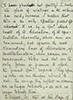
[St Paul Seminary, St Paul, Minnesota.]—Is writing briefly, in order to reach him before he leaves New York for South America. Is glad Smith has left England, as there is little to look forward to there, and in South America there will be more freedom from distractions. His own difficulties are ‘only those that a Cambridge undergraduate who read English under Leavis would tend to feel in a Middle Western seminary’, and some of the other seminarians exhibit ‘intelligence and perspicacity, even in a "Scrutiny" sense’. Encourages him to look up the 'Catholic Worker' in New York, as it is the most vital movement in the Church in America.

PETH/9/9 · Item · 22 Nov. 1911
Part of Pethick-Lawrence Papers

Pleads not guilty, and explains her reasons for having broken windows.

—————

Transcript

(I plead not guilty). I broke the glass of windows as the witness has said, because I realise that this is the only effective protest left to us by a Govt which boasts of its Liberalism, of its representative character, where men are concerned, but ignores the most elementary laws of Liberalism, of Constitutionalism, where women are concerned. Votes and riot are the only forms of pressure to which the present Govt respond. They refuse us votes: we are therefore reduced to riot. The wrongs they inflict on women are no longer tolerable, & we will no longer tolerate them.

I expect, Sir, that at this stage of our agitation, you will recognise—and public opinion will back you in recognising—that, tho having committed the acts, as brought forward by witnesses, we are not guilty of crime, our conduct being fully justified under the circumstances.

I appeal to you to vindicate the fundamental laws of liberty which our country has revered for generations.

I plead not guilty.

Constance Lytton.
Nov. 22. 1911.

MONT II/A/3/8/9 · Item · 11 Oct. 1921
Part of Papers of Edwin Montagu, Part II

Council have not yet decided whether to arrest Gandhi, as replies have not yet been received from the Bombay Government. Inquiries are also being made as to the effect of the Ali brothers’ speeches on the army. They are anxious not to be precipitate, but Reading believes that Gandhi will be arrested. It is possible that the prosecution will take place during the Prince’s visit.

(Mechanical copy of typed original. A duplicate of A3/24/4.)

MONT II/A/3/10/9 · Item · 25 Oct. 1921
Part of Papers of Edwin Montagu, Part II

India Office, Whitehall, S.W.1.—Sends copies of A3/10/5–8 and gives the text of a telegram he proposes to send to the Viceroy assuring him of the Government’s confidence. Urges Lloyd George to use his influence to prevent a debate on India in the House, the main object of which is the continuance of the vendetta of a small but determined group against himself. A debate at this time would cause alarm as to the condition of India, evoke sympathy with seditionists from the extremist benches, advertise and traduce the supposed shortcomings of the Government of India, and advertise seditious utterances and untoward incidents. No new policy is contemplated, and they have no definite statements to make regarding actions against individuals, their main concern being for the success of the Prince of Wales’s visit. Suggests that the Leader of the House should appeal to the small ultra-conservative forces, and that they should be privately assured of the Government’s reasons and motives.—Postscript to Curzon’s letter: Has heard that the debate in the Lords is to take place this afternoon, and is sure that an early intervention by Curzon would go far to discourage further debate.

(Carbon copy.)