Showing 62708 results

Archival description
3351 results with digital objects Show results with digital objects
MONT II/A/1/120 · Item · 27 May 1915
Part of Papers of Edwin Montagu, Part II

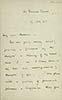
(The British Hospital, Wimereux.)—Is pleased that Oliver is friendly (towards their engagement). Thanks him for the gift of a bag. Discusses her experiences at the hospital. Has been into Boulogne to see Frances and may go to Julian’s funeral tomorrow.

—————

Transcript

May 27th 1915

My darling one your letters are such a joy to me, I cant tell you what they mean. They usually come about 6.30 or 7 & I collect them then, but usually have to thrust them into my pocket & read them later, about 8.30 when we are having a disgusting meal. Tonight I opened one from Asprey first and of course jumped to the conclusion that you had told Geoffrey & that he was hostile and felt very much dashed, however your letter reassured me, particularly as it brought me the news that Oliver also was friendly. Darling its too divine of you to give me a bag. I shall risk being murdered at night for the sake of it, in order always to use it, tho’ so far the only expense I have to meet is 6d a day in train fares to and from Boulogne. Washing will be another item, but that is yet to come! I cant describe to you how disgusting I’ve become, my hands are far far worse than they ever were in the worst London days, As to “experience” it certainly is completely different, thank God, from anything one has ever seen or imagined before, and up to now I dont believe we have had a really bad rush. However I’ve had the priviledge† of seeing a mans leg turn black almost while one watched it, and be whipped off above the knee! Sometimes I feel I cant bear it, its so dreadfully grim, and unlike the other beastly place there are no alleviations, I mean I cant come to tea with you as I did then. My only fun is toiling into Boulogne in a very slow dusty train and seeing Frances for a quarter of an hour, very depressed because Edwards temperature will keep up to 103, and then toil back. Tomorrow I shall perhaps go to Julian’s funeral {1}. Isnt it ghastly? Yet I believe I should be miserable if I had to go home, I cant help hoping the Norman will sack me after my month as I’m afraid I shall never have the strength of mind to say I must leave. And yet I want to see you quite as much as you do me.

Your letters are the only things I read now, I’ve given up books.

I must go to bed now.

Goodnight my most dearest, dont be sad about yourself, I know you are all right, and you know that my judgement is incomparable! I think you’ve been marvellous about all this considering how bloody it is.

Your loving
Venetia

I’ve not seen so much as a glimpse of Gilbert, or of any real human being.

—————

{1} Julian Grenfell was wounded near Ypres on 13 May and died from his injuries in the military hospital at Boulogne on the 26th. He was buried in a cemetery above the town two days later. His sister Monica was at this time, like Venetia, a nurse at Wimereux (cf. A1/148).

† Sic.

Add. MS c/101/120 · Item · 28 Jan 1904
Part of Additional Manuscripts c

Expresses his gratitude for Ward's having called his attention 'to the dialogue between Henry Sidgwick and John Grote in the C[lassical] R[eview] for March 1889' [“A Discussion Between Professor Henry Sidgwick and the Late Professor John Grote, on the Utilitarian Basis of Plato's Republic.” (1889) 3 Classical Review 97], and hopes that he will see his way to publishing it. Refers to the fact that Sidgwick always had an interest in the subject and 'always comes to this question from the point of view of ancient ethics.' Finds it surprising that he never read that 'curious paper', and reports that he 'read with great care [ ] Wilson's mendacious attack upon Archer Hind.' Explains that at the time, however, he had been very busy, and had completely forgotten that the paper had appeared. Remarks that 'anything of Sidgwick's about ancient ethics ought to be considered', since it always seemed to him that the subject 'had an especial fascination for him, and brought out in full force his critical quality.' Returns with the letter the copy of the Classical Review [not included]. Also expresses his gratitude to Ward for his having given him his paper 'on the [ ] of psychology', which he 'shall read with all the more interest' because he is lecturing on [Aristotle's?] De Anima and believes that the paper will very directly bear upon that subject.

Jackson, Henry (1839-1921), classical scholar
Add. MS c/95/120 · Item · 8 Jun 1886
Part of Additional Manuscripts c

States that he would be very glad to assist with the index, but clarifies that what he means by the latter is 'a somewhat fuller table of contents than that in the Encyc[opaedia] Brit[annica].' Admits that he has no experience in constructing alphabetical indexes, but believes that it should not be difficult 'to arrange the chief names and subjects alphabetically. States that he would not advise the change 'from "English" to "British"', and announced that he would prefer the phrase "English and Scottish" to "British". States however that he would not recommend any change in this edition.

Stewart, Alexander (d 1915) Principal of St Andrews University
Add. MS b/35/120 · Item · c 1947-c 1955
Part of Additional Manuscripts b

Embu, Kenia Province, B.E.A. Dated 30.[3?].10 - Has Frazer's [Anthropological] 'Questions' and is at a station where he can study the Bantu natives of Kikuyu stock; has been gathering information, curios, photographs, and would like to get native songs as well with his phonograph, wondered how much they have been studied already.

Add. MS c/51/120 · Item · [2 Nov. 1831]
Part of Additional Manuscripts c

Trinity College - The review of RJ in the Quarterly Review is not to be WW's after all [see WW to RJ, 1 November 1831]. John Lockhart writes to WW to say 'that the article is written without communication with him by a gentleman who had understood that department of the Review to be in his hands etc and has thought it necessary to let this person's review stand rather than lose the benefit of his labours in future'. However, he also says that WW's labour shall not have been spent in vain. This may mean part of it used in the other man's article: 'I expect this will turn out a good thing for you for the man will of course praise your book as opposed to the McCullochites, and you may come to the honour of being the creed of the Tories before your full time. At any rate you will see the impression your book makes on a man not disposed to judge it unfavourably and will get the notoriety of being reviewed in the two opposing reviews immediately'.

FRAZ/15/120 · Item · 24 Oct. 1933
Part of Papers of Sir James Frazer

14 Coates Gardens, Edinburgh, 12 - Is sorry to hear about Sir James' eyesight; cherishes fond recollections of Dr J. Sutherland Black; is enclosing a subscription for the bibliography; until her letter arrived they had not heard of her letter to Mr Buyers Black, who must have misunderstood her meaning.

TRER/7/120 · Item · 1 Apr 1911 [postmark]
Part of TEST

Postmarked Staines; addressed to Trevelyan at the Marine Hotel, Criccieth, North Wales. - Assures Trevelyan that he welcomes improvements [to "The Bride of Dionysus"] at any stage, however late; as it happens the Theseus-Ariadne duet is 'still so unbaked in [his] mind' that all he feels tied to is the 'plan of fitting its structure to that of A's soliloquy on her awakening in Act V'. Trevelyan's 'bare account' of the changes he suggest make the old version vanish into 'fluff'; Tovey expects to get on 'much more vigorously'. He now intends to tackle the openings of Acts V, III, and IV. Trevelyan's sketch of the climax of Act V 'seems very promising'. Tells him again not to fear making any new suggestions, even on parts already scored. Will start on the final full score in August, and 'work at it full-speed till it's done. Till then alterations will still be possible'.

TRER/5/120 · Item · 1 Oct [1929]
Part of TEST

Hotel Infant Isabel, Burgos. - Is very sorry to miss Trevelyan's friends [Francis] Birrell and [Raymond] Mortimer, whom he met at Lady Colefax's 'famous' garden party; it is, though, pleasant to be in B.B. [Berenson]'s 'train' and to be travelling through Spain to Seville and Granada. Will be home around November, so can meet Trevelyan at Cortona then; nobody will be at I Tatti until late December. Will be delighted to see Birrell and Mortimer if they are still in Italy when he returns. Has heard much from Nicky [Mariano] about Trevelyan, and is glad that Welcombe has been sold as planned. Will be very proud if Trevelyan does indeed address an epistle to him in hexameters. Has written an article on Du Bos, and has now been asked for another on Virginia W[oolf], for rather an important journal; proposes one on any new book she might be writing, asks for details and for the book to be sent when it appears. The Berensons seem to be getting on quite well: B.B. complaining a little about his health, and Mary about 'romanic art' [sic], which is a topic for discussion due to the book about Jerusalem she is writing. B.B. says the countryside is 'more desertic and arabic than Syria'. Has read Trevelyan's letter out to the company: they expect him at I Tatti when Mary and Nicky return in late December, though B.B. will stay with Mrs Wharton until New Year; thinks Ray and Karin and their families will also be at I Tatti.

TRER/3/120 · Item · 21 Oct 1920
Part of TEST

Postmarked Weybridge. - Thanks for the loan of [Norman Douglas's] "South Wind". Forster's books are being published in America by Knopf: would be nice if Trevelyan's friend [unidentified] could get some connection with Knopf.

TRER/46/120 · Item · 22 Dec 1906
Part of TEST

The Shiffolds. - Dr Clarke says that Bessie 'could not be doing better'; Paul is also very well, and 'sleeps a fair amount'; Clarke will come again tomorrow. The nurse 'manages splendidly'. The household is also getting on very well: Mrs Ent[icknap] 'takes a great deal of trouble' and Alice also 'helps well'. Gussie [Enticknap] was 'kept in the dark until yesterday evening', when his mother took him to see the baby; he 'seemed very much astonished'. He thinks he will 'soon have someone to play cricket with, but that is looking forward too far'.

Everyone thinks the baby looks a lot like Robert; supposes he must be, but to him he 'looks far more like Mr Finch'; asks his mother not to tell this to Finch. The baby is 'certainly very healthy and a fair size, 7 1/2 lbs and 20 inches'; his hair is 'about Bessie's colour, or a little darker, and his skin is rather brown'.

Lady V[aughan] Williams has just called to enquire and invite Robert to High Ashes for lunch; thinks he will go, as Bessie usually sleeps after lunch. Miss [Sophy?] Wedgwood and Margaret Vaughan Williams also came to see the baby this afternoon, and 'thought him very charming'. Does not think he missed writing to anyone: sent telegrams to Aunt Anna, Aunt Meg, Uncle Harry, Aunt Nora, Janet, Molly and a few others. Sends love - also from Bessie and Paul - to his father; will write to him next. Must finish now as the post is due.

TRER/12/120 · Item · 24 Nov 1907
Part of TEST

Grand Hôtel Continental, Siena. - Rather 'arctic' in Siena; Hilda Trevelyan has been staying here a while and will come to tea tonight; she is leaving tomorrow. He and Caroline enjoyed Florence very much; all the new building is in the suburbs so the 'essential part of the city' is not at all spoiled. They had a good visit to the Berensons, whose house must be good to stay in. Supposes Robert is at Cambridge today. Sends love to Elizabeth, with assurances of their interest in Paul and his 'troubles'; made friends with a 'lovely little Italian baby' in a street near the Duomo yesterday. Has read about the Sicilian property [left to Robert by Florence Trevelyan, but only after her husband's death]; does not feel great confidence and dislikes the way the will was arranged in Sicily rather than by the Trustees' lawyer, which benefits Dr Cacciola; however, Robert 'is in good hands,' and his financial prospects mean he need not 'undertake certain worry for an uncertain prospective gain'. Is very interested in the third volume of [Guglielmo] Ferrero's ["The Greatness and Decline of Rome": "The Fall of An Aristocracy"] and has Cicero's "Philippics" with him. Currently reading the "Heauton Timorumenos" [Terence's "The Self-Tormentor"], which is a 'rattling comedy'.