
The Mill House, Westcot, Dorking. - Hopes to decide today whether the second post reaches its destination at the same time as the first. Had a busy time in London, spending much time with Sanger before he left for Greece, as well as dining out, going to Fry's lecture, and to see "Richard II" with [Thomas Sturge?] Moore and Binyon. Returned on Wednesday and has done some work; saw Fry and they discussed Sanger's illness; he is 'desparately in love with someone who is behaving very cruelly to him [Dora Pease]' and he does not know what she feels for him. Will tell Bessie more when he sees her. Certainly good for him to go to Greece with Dickinson, Daniel, Wedd and Mayor. Saw them off at the station and 'felt desperately incline to go off with them'; they were so cheerful, even Sanger, and he has always dreamed of going to Greece, which they know so well; regrets that after his marriage he will not be able to go with them 'with who one can talk as freely as one chooses, as blasphemously, as obscenely, as wittily, as learnedly, as jovially as any of the old Greeks themselves did'. Feels he should have 'made hay more assiduously' during his bachelor days, instead of living 'mewed up' alone in the countryside. Knows Bessie will compensate him for all he is to lose; she must come to Greece before long or she will find him 'running off' without her. Praises "Richard II"; it was well acted, though he thought the Richard [Frank Benson?] "vulgar". Has written to his Aunt Meg [Price]; she seems happy to get them a 'cottage piano' which will later be exchanged; asks if Bessie wants the final choice of the instrument or whether she trusts his aunt's 'professional friend' to do this. Sophie is 'Miss Wickstead [sic: see 9/117]], not some young lady friend' he has not told her about.
Welcombe, Stratford on Avon. - Very sorry to hear of Charles Booth's illness; fears Amalfi is 'rather a comfortless place to be ill in', and he will be better at the Palumbo [in Ravello]. Sir George is better, though rather low and his leg still troubles him. They go to London on 15 February. Has lunched at Cheyne Gardens on a day's visit to London; Janet was well and 'declared that the 10th was the day of arrival [of her baby]'; they will see. Has seen nothing of Robert's play ["The Birth of Parsifal"] yet, but expects it will be published before long; hopes his work now goes well. Knows 'the sort of politician Mr [Thomas] Omond is: the 'wave of reaction has been too much for him'. Glad this now seems over; the political future is 'very uncertain' but she thinks things will be better now, though 'the difficulties are great'. Finds the current religious revival in many places including Stratford 'very curious' and 'evidently a reaction against the materialism of the last years'; such things never last long, but she thinks it will ;turn the attention of large classes to serious matters, & so do good'. Glad the Grandmonts are well; asks if Miss Reid is better; sends love to Meg [Booth] and hopes she and Elizabeth are happy.
Postmarked Weybridge. - Has written to Sassoon; has sent Charlie a little of his own money as well. Has given a lecture on Egypt to the Secular Society at Leicester. Would like to borrow a copy of Norman Douglas's "South Wind".
13a Hanover Terrace, Ladbroke Grove, W.11. - Asks if Bessie could send for him to Gomshall rather than Ockley, as he would like to visit Edward Carpenter at Guildford. Discusses arrangements.
Wallington, Cambo, Northumberland. - Thanks Robert for spotting two errata in his book [the third volume of "The American Revolution]. Has a 'good sketch' of what remains to be written, but doubts he will have time to do it. Glad that, like Robert, 'everyone with taste and judgement' would like more "Marginal Notes" [by Macaulay] but agree it was 'probably wise to limit them'. Looks forward to seeing Robert and Elizabeth next week.
Aldworth, Haslemere, Surrey. - Thinks that Trevelyan had better furnish the house [Roundhurst] now; the Tennysons might buy some of the furnishings from him 'at a valuation'. Would advise Trevelyan to bring his own caretaker, who will not 'make a "good thing"' of him as 'the chance [?] Haslemere caretaker might be inclined to do'. Asks to be remembered to Sir George and Lady Trevelyan; Lionel and Aubrey [his sons] send their love.
Kensington Palace Mansions, W.8. - Very sorry that he cannot make his promised visit to Trevelyan after all; has 'foolishly... consented to give a lecture next week' and needs the time to prepare; very sorry as he was much looking forward to spending a quiet weekend with the Trevelyans. Sends apologies and thanks, in which [William] Pearson joins, to Mrs Trevelyan.
39 Marina [St Leonards]. Reading Macaulay.
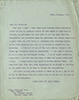
Agrees in deploring the suppression of artistic works. The seizure of Malleson’s plays is evidence of their power to kindle the imagination.
—————
Transcript
31st. October, 1916.
Dear Mr. Malleson,
Yes alas—when I sent round next morning after writing my letter to you to purchase copies of your Plays to send away to my friends, my messenger was told that it was too late, {1} that the Authorities had descended upon the publisher and seized every copy. I agree with you that there is something very menacing indeed in the fact that even {2} the work of an artist is subject to suppression. I think it is one of the most serious dangers with which any Community could be confronted. I see that a question is to be asked in Parliament to-day. I am of course extremely sorry that I did not read the Play at once and secure additional copies. I congratulate you again on having written them. The very fact that they have been suppressed is in itself an evidence of the power that is in them to kindle the imagination.
You won’t forget your promise to write to me in a day or two to fix an afternoon when you could look in and see me, or ring me up over the telephone.
Yours with all good wishes,
[blank]
Miles Malleson Esq.,
“The Attic”,
43, Bernard Street,
Russell Sqre. W.C.
—————
{1} Mistyped ‘thateven’.
Savoy Hotel, London WC2 - Thanks him for his good wishes on the first night of 'Sail Away'.
The Athenaeum Club - CL hopes WW did not object to the revisions made to his article for the Quarterly Review by its editor - John Gibson Lockhart [Review of 'Lyell's 'Principles of Geology', volume 2', Quarterly Review, 1832].
Apologises for not writing to Sidgwick sooner, and explains that the delay was due to absence from home and illness. Reports that he has gone over the article in Encyclopaedia Britannica, and gives a brief summary of suggested alterations, including development of the introductory chapter; division of the treatise into chapters and sections, with headings, brief summaries and tales, and with regard to Professor Bain's summaries in his Mental and Moral Science; names of subjects, 'even a brief analysis of the outstanding works - such as Plato's Ethical Dialogues, Aristotle's Ethics...'; a fuller treatment of Reid and Stewart, and 'Scotch philosophers generally', as well as more space dedicated to the French influence, and mention of more modern tendencies, such as Pessimism. Reports that Sidgwick's book [as a text-book] has been announced in the April issue of the Mission Record. Expresses an interest in seeing the proof sheets.
Stewart, Alexander (d 1915) Principal of St Andrews University7 pp. ms. draft + 1 p. Appendix.