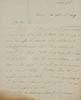
Clarendon Press, Oxford.—Comments on the text, and suggests alterations.
(A handwritten message, with seven sheets of typed notes, of which the first six are numbered 2-7 and the last is unnumbered.)
—————
Transcript
The Clarendon Press, Oxford
1:1:26
Part III I p. 4 dele ‘or even non-existent’? I see what you mean, but it is awkward.
p. 10 Johnson’s Letters printed (from his MSS) in 1788 and in 1791. The printer normalized nearly all J’s (not infrequent) odd spellings.
Jane Austen always wrote beleive, neice, and even veiw. Hardly any trace of such spellings survived in her novels, except that in the first edition of Mansfield Park (which is very badly printed) a few spellings occur such as teize, which is undoubtedly Janian.
RWC
RBMcK.
[Additional notes:]
[Part I, Chapter vii?] p. 24
If you bring in stereos perhaps you ought to mention the nobler art of electroplating, {1} though I cannot say off-hand when it was introduced. The footnote perhaps needs modification. I believe that the introduction of stereos into America is quite recent. Frank Doubleday told me in 1920 that he was trying to persuade his people that it was possible to print from stereo; but when I asked him in (I think) 1925 if he had succeeded in doing so he said the resistance had been too strong for him. I am not quite clear if the second half of the footnote refers to America only. We should not willingly accept it as true of ourselves. In the first place (and this affects your text as well) we very often print a book in the first instance from plates. No type used in the New Eng-lish Dictionary ever touched the paper; and we should as soon think of printing a bible from type as of infringing the Thirty-Nine Articles. No printer would dream of printing a book like the Pocket Oxford Dictionary from type, unless he set it by machine, for no one would have enough type to produce it at any decent pace. The same is of course true of such books as Liddell and Scott. And when we set up a book of which we expect to sell a great many copies, e.g. the Oxford Book of English Verse, we make electroplates before printing, in order to keep the type perfectly clean. Indeed (and here I let you into a state secret) we make two sets of plates, so that if the first gets worn out a second may be made from the unused set. N.B. This is not true of the Oxford Book of English Prose, and is very exceptional. You mustn’t print too much of this information.
Chapter viii, p. 2
I believe that in the United States signatures are regarded as obsolete. {2}
[Chapter viii,] p. 11
Printing with figures. It might be interesting to infer, by comparison of a number of books printed by the same printer in the course of a few years, how many presses he possessed. I do not think I have ever seen a ‘figure’ consisting of two digits, or, if I have, certainly nothing above 12.
Chapter viii, pp 7-8
I think, indeed I am sure, that the normal place for both watermarks was the centre of the half-sheet. {3} I do not remember an ‘excentric’ {4} watermark before the very end of the eighteenth century. In my experience of the eighteenth century, paper far oftener than not had two water-marks; and I suppose the intention of putting the mark or marks in the centre of the half-sheet was that it should be visible in the finest kind of book for which the paper was used, namely a folio. N.B. My Rawlinson MS of 1674 shews that the double watermark was well established by that date. {5} After about 1800 I think watermarks appear in all sorts of funny places.
Chapter x, p. 3
My copy of Brooke’s Gustavus Vasa (a subscriber’s copy on Royal paper) has two blank leaves at the beginning and two at the end, not forming part of the book as printed, but included in the stabbing.
[Chapter x,] p. 4-5
Unfortunately I cannot lay my hands on such evidence; but my impression is that publishers’ boards are a good deal earlier than you suggest. Eighteenth Century publishers’ advertisements give price sewn, price in boards, price bound. Sometimes, though not normally, two of these are given as alternatives. My impression is that ‘price in boards’ is as common earlyish in the century as ‘price sewn’. A Dodsley pamphlet of 1754, which I happen to turn up, has in half a dozen places ‘price bound’. Pamphlets were issued also in wrappers. {6}
Part II.
Chapter iv, p. 1
Except of course in collected editions. The first edition of Thomson’s Sophonisba is octavo, the second edition is a very handsome quarto, printed to complete ‘the second volume of Mr Thomson’s Poems’, which consists mainly of the unsold and unsaleable sheets of the first edition of Liberty, and was produced with a special title-page uniform with The Seasons.
I suggest the avoidance of the word 12mo., which is as ugly to the eye as to the ear. Why not twelves? ‘(But you can’t say a twelve!)’ {7}
[Chapter iv,] p. 8.
Today the cost of blanks is due, not so much to waste in machining, as to the fact that we have to pay the compositor for the blanks as if they were full. But I do not know how far back that goes.
Chapter Vi†, p. 2
See my edition of the Tour to the Hebrides, p. 324, from which you will see that Boswell ‘hastened to the printing-house’; and also p. 481, which refers you to the notes to pp 232, 291, 324. I have recently been examining the revises (so-called by Boswell himself) of the Life of Johnson. These were regularly marked ‘For Press’ or ‘Send another revise’, and corrected by the press reader and by the author in a manner differing hardly at all from the modern practice. I am afraid I do not know of any proofs, except those you mention, earlier than about 1780, nor do I know of any surviving MSS which have been through the printer’s hands earlier than about that date. {8}
[Chapter Vi,] p. 287 (of the original print)
Bywater used to tell me that he had no doubt of the existence of picked copies; and I remember his shewing me a book which he believed to be a picked copy intended for presentation to some great man; but the process of picking would probably have reference to technical excellence (freedom from flaws in the paper and the like) rather than to the selection of sheets containing the corrected readings. But I can quite imagine Boswell, for instance, instructing Messrs Dilly to pick for say Sir Joshua Reynolds a copy containing the latest state of the sheets. {9}
Chapter ix
I demur to your expression (p. 4) ‘The text which embodies the author’s latest corrections should as a general rule be decisive in questions of reading’; I prefer your original wording ‘should be the basis of a modern edition’. In all the eighteenth and nineteenth century texts which I have edited and in which this question comes up I have found that variants must be judged upon their merits; there are, for example, readings in the third edition of the Life of Johnson which might be defended if they stood alone, but which fall to the ground the moment they are compared with the readings of the first and second editions, because they are explicable as printer’s errors and wholly inexplicable as author’s corrections. Sometimes of course (though not relatively very often) one has difficulty in making up one’s mind whether the author made a correction or the printer a mistake. There are quite gross errors in almost every edition of Boswell which ought not to have been perpetuated.
This is so far as I have got, but I hope to finish Part III in a day or so.
I will return the whole thing as soon as I can.
N.B. I have overlooked one or two notes.
Part II, chapter ii, p. 11
My uncut copy of Peacock’s Misfortunes of Elphin has the rough margin of the sheet at the top of the page, and the insets (the book is a duodecimo imposed for cutting) are much shorter at the top than the rest of the book.
Chapter iii, p. 3
I do not understand the expression ‘Printer, i.e. presumably publisher’. Ought you not to make it clearer why you presume this? {8}
RWC
—————
The handwritten message has been transcribed first above, though it is pinned between the last two of the other sheets. The additional notes are typed, except for a few corrections and additions (see below). The numbering of these sheets appears to indicate that one sheet is missing from the beginning. Chapter references repeated from the previous entry are omitted in the MS, but they have been supplied above in square brackets.
{1} Cf. Introduction to Bibliography, pp. 71-2.
{2} McKerrow has added the note: ‘(A fair number still)’.
{3} Cf. Introduction to Bibliography, p. 102, note.
{4} ‘x’ altered from ‘c’.
{5} Chapman has struck through the following sentence here: ‘(This wants verification; but my Library paper, p. 75, says ‘watermark’ or ‘watermarks’).’ The reference is to Chapman’s ‘Notes on Eighteenth-Century Bookbuilding’ in The Library, 4th series, iv, 175 (sic).
{6} This sentence was added by hand.
{7} This sentence was added by hand in the margin.
{8} There are pencil lines, or ticks, through this paragraph.
{9} There is a pencil line, or tick, through this paragraph.
† Sic.