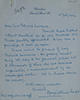
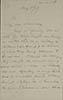
Claridge’s, Brook Street, W.1.—Thanks him for his kindness during her stay in England. Has missed the presence of Lady Pethick-Lawrence.
Penrhôs, Holyhead.—Refers to his planned visit to Alderley in November, and invites him to Penrhôs later that month to shoot. They leave Penrhôs on the 6th (for Alderley), after which she goes to London and then Hopeman. Benn is still with them. She enjoyed her voyage on the Enchantress very much.
—————
Transcript
Penrhôs, Holyhead
September 22nd 1913
This is merely a line about plans. I believe you are coming to Alderley on about the 10th arent you for a Sunday (November I mean) {1}. Will you also come here on the 27th of the same month, I think it is a Thursday {2} and shoot the Friday and Saturday. Arthur has just decided that it is worth while coming over to shoot the pheasants which throng these woods! Violet is also coming. We shall have rather fun. Do come. You cant be have meetings in Cambridge then.
I wonder if I shall see you before that, everyone I meet tells me how delightful you are! We leave here on the 6th and I go to London for a few days on the 13th and then the week after to Hopeman. Perhaps I shall see you in London.
I came back here on Wednesday {3}. I was heartbroken at leaving the Enchantress, I’ve seldom enjoyed anything so much. But its nice here, dear little Bluey has just left, Mr Benn remains behind. He’s a strange keen alert little creature. He starts every conversation with such hope and enthusiasm, it seems so cruel that every time he must find it falls short of his expectations.
I’ve loved my summer this year, and am really sad its over. Have you had fun? There are such a lot of things I want to talk to you about, I hope I shant forget them when we do meet.
Your
Venetia
—————
{1} 9 November.
{2} It was.
{3} 17th.

Lists of guests and notes for visit to Zomba, Nyasaland
1947'Copy of the Industrial Charter with papers and press cuttings about it, papers on Conservative policy for dealing with the economic crisis, correspondence re Courtaulds Ltd and ?preparation of Industrial Charter
Thanks him for his help with his term paper on Salieri, was thrilled to hear from him; is in a quandary as a playwright on how to write plays to offer to the American stage.
JH will be sorry if his eldest daughters are absent during WW's visit.
News concerning the bust being made of Richard Sheepshanks.
Woodend, Perth Road, Dundee - Was very amused by the story of the lady in the bath; John Jr. is on leave from his ship, while Frances was visiting; Frances is going to London and then to France; has just seen an 'aeroplane' floating over their heads; the nearest bomb raid was at Carnoustie.
States that the reasoning Dodgson has sent to him is invalid in the last two steps, and explains his conclusions through logical equations. Adds that if Dodgson has 'ingeniously concealed some pitfall into which [Sidgwick has] artlessly fallen', he must bear in mind that [Sidgwick] is professionally a moral philosopher, and not a logician.
Complains about the alterations made to his article, which appeared in that month's issue of Fraser['s Magazine for Town and Country]'. Explains the argument behind one passage that was omitted in the publication, in which his 'general drift was that if you make an action accidental you have no motive for gratitude.' In another omitted passage he had argued that it is right to do 'what will cause most happiness irrespectively of the subject of the happiness...' In yet another excluded passage he had argued that a belief in future rewards and punishments 'would not really reconcile selfishness and utilitarianism, but only (in short) sanction selfishness.' Announces that he will not see Sidgwick at the Ad Eundem as his mother has just died.
Sans titreWW is pleased that JCH agrees that Prince Albert is the fittest person for Chancellorship: 'all people here fall in with the plan, except the Johnians who have put forwards Lord Powis, and must wait to see what he will do'. WW is glad that no one thought of Lord Lyndhurst: 'Indeed I do not see how they could, after (not to speak of other grounds) the atrocious bad faith of the heads of the party to their followers'. WW gives a brief history of an impoverished Trinity sizar, John Cartman, who WW sent away on finding his 'character and conduct not good'. He has subsequently become a private tutor and WW hopes he has mended his ways.
Remarks on how bravely Henry Sidgwick met his death, especially since he was not by nature an athlete. Observes 'how little people know of what is [ ] worth knowing in the lives of their friends', and reports that a hint from his son Hilton, who is editing the Cambridge Review, encouraged him to try and remedy this 'in one conspicuous instance.' Hopes that he has said nothing that could offend the feelings of those nearest to Henry. Refers to the latter's letter to Young 'announcing the meeting at St John's, and inviting [him] [the only non resident admitted] to it', and to the use he [Young] made of the announcement 'to bowl over Charles [Roundell]', who had told him the same day of the Oxford resolution he mentions in his letter to the paper. Adds that when Cowell Williams sent him the resolution of thanks passed by the D[ ] Deputies and the [Liberation] Society he sent it on to Henry, 'and told them it was his due.'
Sans titreThanks Nora for her letter. Thinks that Henry Sidgwick: A Memoir 'recalls a great deal of [Henry] to those who knew him', but fears that it would not give to those who did not know him 'any full reflection of the indefinite charm [there was] of his conversation or of the loveableness in his nature.' Admits that it is impossible to reproduce conversation in writing. Relates that he followed Henry and other friends in joining the Free Christian Union. Refers to J. J. Taylor, and suggests that his name is spelt 'Tayler'. Suggests that the Union was in some sense a precursor of the Christian Social Union and the Christian Social Service.
Sans titreWrites to express his sympathy with her on the death of Henry Sidgwick, who was by far the dearest and most helpful teacher and friend that he ever had; prays and believes that his personal influence will never leave those who have been left behind.
Sans titre(Bibliog. 103).
5pp. typescript draft with ms. corrections.
One ms. letter only, from Wilson 1955, on lightning strikes on trees, written after Taylor had had a narrow escape. Wilson also refers to his recent flight, at the age of 86, in an RAF aircraft.
The folder includes photocopies of 2 letters, 1956, from Wilson to B. Vonnegut, on electric storms.