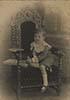
Perhaps the photograph shows Richard Appleton in his rooms at Trinity, but the subject and the location of the room have not been identified.
The photograph shows a small boy, probably in a studio setting, sitting on an ornate chair with a small open cardboard box beside him. The name of the publishers, ‘E Day & Son Bournemouth’, is written on the mount. Since the firm did not acquire this name till 1873, the boy cannot be Richard Appleton.
The name and addresses of the publishers, ‘Barrauds Limited, 263, Oxford St., London, & 92, Bold St., Liverpool’, are printed on the mount.
There is no date in the booklet, but the book referred to, which was published in 1897, is described in the heading as ‘now ready’.
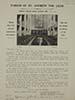
The letter includes a photograph of the interior of the church, and is subscribed by J. Gilbert Dixon, vicar, and Arthur Barrett and Arthur Rutter, churchwardens. At the foot has been added by hand, ‘Upwards of of £50 have already been subscribed’.
The heading is, in capitals, ‘The Stained Glass of the Great West Window, King’s College Chapel, Cambridge, by John R. Clayton and Alfred Bell.’
Engraved by Francesco Bartolozzi and Charles Grignion from a drawing by Edward F. Burney. Engraving published 17 July 1786. It is unclear which edition or volume this comes from.
Parts of the engraving have been cut away.
Designed and engraved by Abraham Bosse.
Engraved by W. Leney (William Satchwell Leney) from a drawing by Mather Brown. Includes a dedication to Lord Rawdon. For the date cf. British Museum, No. 1983, U.2306.
Engraved by Thomas Rowlandson from a design by Polypus. Engraving published 18 Apr. 1807.
Designed and engraved by Abraham Bosse. It is unclear which edition this is from, but cf. the loose item after f. 115.
Transcript
Trinity Lodge, Cambridge
March 10th 1891.
My dear Librarian,
I have the pleasure of sending you, in a truly splendid dress, the Autograph Score of Doctor Hubert Parry’s “Blest Pair of Sirens.”
I am to-day writing to thank him for his generous gift, which was formally accepted by the Council last Friday {1}.
The letters of Doctor Parry and Professor Stanford {2}, which I enclose, will, I trust, be preserved.
Believe me to be
Most truly yours
H. Montagu Butler
—————
{1} 6 Mar.
{2} The other two letters pasted into this volume.
Transcript
Royal College of Music, Kensington Gore, London, S.W.
My dear Charlie
You told me some time ago that I should be doing nothing amiss if I offered the original score of my setting of Miltons Ode “Blest Pair of Sirens” to be deposited in the Library of Trinity—An honour I should not presume to think of on my own account. I have had it put into a coat probably more worthy of such a position—as coats go—than the work itself, & confide it to you as its best possible godfather. Which you have been from the beginning!
Ever yours
C. Hubert H Parry
Transcript
10 Harvey Road | Cambridge
March 2. 1891
My dear Master,
I have the pleasure to send you with this the original autograph score of Hubert Parry’s ‘Blest pair of Syrens,’ which he wishes to present to the College for the Library. It struck me some time ago that as the College possessed the Manuscript of the poem, {1} it would be of interest & of value to them to possess also the original of the magnificent musical setting. Parry was, as is his nature, most unwilling at first to do anything which looked (as he put it) so “bumptious,” but I quieted his qualms on that point.
I send you herewith a letter {2} he wrote to me asking me to forward the score to the Council, & which, as it is really addressed to them altho’ through my mediation, I should be glad, if they wish, to leave in their hands.
Believe me, my dear Master,
yrs very truly
C V Stanford
—————
{1} R.3.4.
{2} Parry’s letter of 28 Feb., also pasted into this volume.
(The index lists the names and degrees of the writers of the contents. It includes the name of J. Cumming (BA, 1801), but there is no declamation by him in the volume.)
Paris.—Sends him a copy of the discourse he addressed to the general assembly of the Beaurepaire section [of Paris] on 25 Dec. 1793 (see ff. 1–7 below). Has sent a copy to the Committee of Public Safety, offering his services to the committee as a political agent in America, Gênes, Venice, or the Swiss cantons. Asks his correspondent to support this proposal if he has occasion to speak to any member of the committee.
(Inscribed ‘From the Author’. There is no fellow or tutor of Trinity named John Jones. The subject of the elegy is presumably Thomas Jones, who was a tutor at Trinity from 1787 till his death in 1807, though he did not achieve the degree of BD.)
These leaves are paginated 39–40, 29–38, 41–64 in red pencil.
(An earlier draft of the briefs on ff. 1-7.)