
SRAF/D/3/11/113
·
File
·
[1938]
Part of Papers of Piero Sraffa
3351 results with digital objects
Show results with digital objects
BUTJ/A/1/113
·
Item
·
10 Feb 1918
Part of Papers of Sir James Butler (J. R. M. Butler)
Thanks him for his good wishes on becoming Master of Trinity.
BUTJ/M/5/1/113
·
Item
·
6 Dec 1915
Part of Papers of Sir James Butler (J. R. M. Butler)
Reserve Trenches Tremendous bombardment by Cape Hellas, encloses picture of regiment [wanting], lecturing novices on the use of machine guns.

PETH/6/113
·
Item
·
12 Mar. 1912
Part of Pethick-Lawrence Papers
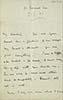
Brixton Prison.—Nance has visited and Uncle Edwin has sent a goodwill message. Has been thinking about his defence and reading The Solitary Summer.
—————
Transcript
Brixton Prison
12th March 1912
Dearest
Just a word in pleasant anticipation of seeing you on Thursday. I had a delightful visit from Nance this afternoon and am looking forward to seeing May tomorrow. How very good everyone is to us!
I have been busy today looking into the question of my defence but of course there is not very much one can do until we hear what the other side have got to say.
I think I told you I had had a letter from my sister Annie, I have also received a message of goodwill from my uncle Edwin[.] I am going to write to him tomorrow.
The book Sayers has sent me is “The Solitary Summer” which is very good reading—I have only read before “Elizabeth and her German Garden” {1}.
I expect you see the Times, there is a capital letter today from Annie Besant.
Your own loving
Husband
—————
One folded sheet. At the head is printed, ‘In replying to this letter, please write on the enve-lope:— Number 3408 Name Lawrence F P’, the name and number being filled in by hand. The word ‘Prison’ of the address and the first two digits of the year are also printed, and the letter is marked with the reference ‘C1/12’ and some initials. Strokes of letters omitted either deliberately or in haste have been supplied silently.
{1} A popular semi-autobiographical novel by Elizabeth von Arnim, first published in 1898. The Solitary Summer, a companion piece, was published the following year.
PETH/7/113
·
Item
·
7 July 1901
Part of Pethick-Lawrence Papers
20 Somerset Terrace (Duke’s Road, W.C.).—Reflects on the nature of their love.
SMIH/2/113
·
Item
·
20 Oct. 1889
Part of Papers of Sir Henry Babington Smith
SMIH/74/113
·
Item
·
27 Aug [1895?]
Part of Papers of Sir Henry Babington Smith
RAB/A/113
·
File
·
1926–1928
Part of Papers of Lord Butler
BACH/F/3/113
·
File
·
31 Oct 1955
Part of Papers of G. K. Batchelor
SMIH/95/113
·
Item
·
11 Oct 1889
Part of Papers of Sir Henry Babington Smith
GREG/1/113
·
Item
·
22 Jan. 1904
Part of Papers of Sir Walter Greg (W. W. Greg)
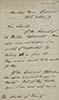
Trinity College, Cambridge.—Thanks him, on the College’s behalf, for his Catalogue of the Capell Collection.
—————
Transcript
Trinity College, Cambridge
22 January 1904
My dear Greg
I have the great pleasure of conveying to you by desire of the Council the thanks of the College for the admirable Catalogue of the Capell Collection which you have completed with such care. For the first time it will be possible for outsiders to know what it really contains.
Believe me to be
Yours very sincerely
W. Aldis Wright
V. M. {1}
Walter W. Greg Esq.
—————
{1} Vice Master.
Add. MS a/200/113
·
Item
·
9 Oct. 1856
Part of Additional Manuscripts a
Flamsteed House, Greenwich - GA has already sent three copies of the Account of the Haston Experiments [see GA to WW, 1 Nov. 1854]: 'Pray cause a search to be made for them'. Two copies of the Greenwich Appendixes were sent to WW: 'But if they trouble you, I can send only one in future'. GA will think of a time when they can 'talk over Italian and other matters'.
Add. MS a/211/113
·
Item
·
22 Sept. [1842?]
Part of Additional Manuscripts a
Asks WW to help him gain a government pension by signing 'a kind of recommendation'. Needs a pension to carry on his 'antipapal and antifatalistic warfare'. Thinks Dr. Latham and Dr. Lee would sign the recommendation. Wants WW to forward the sale of his remaining copies of 'Anti-Popery' as it sells slowly. Needs money to pay printers bill. Booksellers want a cheap third edition to reach 'the poorer kind of readers, especially in Ireland'. When they met last Rogers disappointed in WW's commitment to helping him. Wants WW to reconsider.
Add. MS c/51/113
·
Item
·
9 Oct. 1831
Part of Additional Manuscripts c
The Athenaeum Club - WW sends RJ 'some lucubrations on the subject of McCulloch's review...Do not be alarmed - I am not going to publish them in a hurry or probably at all'. WW does not 'care so much about abusing Peter as about setting the matter on its proper footing - they are suggested as much by talking with the Ricardites as by the Review'. WW finds 'that people have by no means made out clearly what is new and peculiar in your doctrines and they will be long in doing it except it is put somewhere in a short compass to begin with. My view was to write what might benefit the political economists at the Athenaeum'. WW has only spoken to two or three people on political economy - 'for nobody talks of anything but reform'.
Add. MS c/87/113
·
Item
·
20 Dec. [19th cent.]
Part of Additional Manuscripts c
Add. MS c/90/113
·
Item
·
1 Sept. 1853
Part of Additional Manuscripts c
Add. MS c/91/113
·
Item
·
22 Jan. 1834
Part of Additional Manuscripts c
49 Upper Bedford Place -
Add. MS b/113
·
File
·
[19th cent.]
Part of Additional Manuscripts b
Volume of letters arranged alphabetically by correspondent, with usually no more than one letter per person, each correspondent identified at the top of the page on which the letter is mounted, in the form of an autograph book.
Carus, William (1804-1891) clergyman
Add. MS c/101/113
·
Item
·
30 Jun 1900
Part of Additional Manuscripts c
Thanks him for his 'kind and interesting letter.' Refers to his incurable disease and the effect that it would have on his quality of life and ability to carry out his work. States that it has caused him to value all the more the kindness of his friends. Feels that he is unworthy of von Hügel's praise, but appreciates the recognition of his friends of the work, which he looks on as incomplete and imperfect. Does not know what the future holds, and states that as soon as he is physically strong enough he will 'endeavour to endure [the] habits of daily work', but that he has been 'warned against anything like fatigue.' Claims that he shall be very sorry if he is not able to write something more on the subjects on which they have exchanged ideas at the Synthetic Society. Expresses his sympathy with Von Hügel in his anxiety about his sister's health.
Sidgwick, Henry (1838-1900), philosopher
HOUG/45/113
·
Item
·
29 Oct. 1833
Part of Papers of Richard Monckton Milnes, Lord Houghton
Forwarded from Venice to Milan by [Thomas] Holme.
FRSH/A/113
·
File
·
1938
Part of Papers of Otto Frisch
'J. Frisch - Sweden 1938'. Frisch's original folder also inscribed 'Eltern', of correspondence and papers July-November 1938 re closure of the Bermann-Fischer firm in Vienna, attempts of J. Frisch to obtain a post in Britain, his internment in Dachau and eventual success in obtaining a labour permit to work with his previous firm in Sweden.
FRSH/B/113
·
Item
·
n.d.
Part of Papers of Otto Frisch
8 pp. typescript, no author or date.
TAYL/A/113
·
File
·
1964-66
Part of Papers of Sir Geoffrey Taylor (G. I. Taylor)
Presented by Taylor on the occasion of the Centenary. Correspondents include J.O'Malley (Royal Irish Academy), E.F. O'Docherty (University College, Dublin), M.A. MacConaill (University College, Cork), D.T. Piper (National Portrait Gallery)
ADMS/E/113
·
File
·
1975-77
Part of Papers of Frank Adams
THMG/G/113
·
File
·
1967
Part of Papers of Sir George Paget Thomson
DOBB/C/A/113
·
File
·
1955–66
Part of Papers of Maurice Dobb
FRAZ/15/113
·
Item
·
[Oct.? 1933]
Part of Papers of Sir James Frazer
The Folk-Lore Society - A form letter sent to British societies and institutions of which Sir James is a member announcing the publication of the bibliography and suggesting that each institution subscribe for two or more copies. With notes in Lady Frazer's hand at top asking for the return of the letter, and with a note to the Secretary: '2 1/2 stamp please or letter will be refused'.
FRAZ/4/113
·
Item
·
1 Jan. 1925
Part of Papers of Sir James Frazer
Court Leys, Toot Baldon, Oxford - Congratulates Frazer: it is good that the 'larger, but perhaps less instructed body that we call the state' has recognized his work.
FRAZ/33/113
·
Item
·
[192-?]
Part of Papers of Sir James Frazer
Thanks them for visiting, is sorry to have missed them, this is his first letter since the operation; they will not hear from his wife for some time, as she has been extremely ill.
TRER/8/113
·
Item
·
11 Mar 1926
Part of TEST
The Pantiles, Englefield Green, Surrey. - Asks Trevelyan if he could do Eugenie Schumann, and thereby her, a favour by letting her know quickly what he thinks of Marie Busch as a translator from German into English. She is telling Miss Schumann that from what little she herself saw of her, Miss Busch knew both German languages well, but would appreciate a few lines from Trevelyan. Hopes the Trevelyans, including Julian are very well. Asks in a postscript that her question be kept a secret, as Miss Schumann requested.