Affichage de 62708 résultats

Description archivistique
3351 résultats avec objets numériques Afficher les résultats avec des objets numériques
Add. MS c/100/110 · Pièce · before July 1888
Fait partie de Additional Manuscripts c

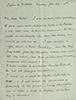
Reports that on receiving Myers' 'excellent' news he 'went and settled with the P[etty?]s finally on the terms of Mrs P's last note.' Announces that they will probably come on 'Sat. 29th.' Announces tha the should be delighted to dine in [H]. Sq. on 13th if there is no séance', but asks ought they not to have [William?] Eglinton there. Says that he will dine on Wednesday wherever Myers likes, but doesn't particularly want it known that he is in town 'for this purpose', and therefore doesn't want the Savile [Club]. Adds that Gurney is 'ever so much better.'

Add. MS c/94/110 · Pièce · 16 Sep 1886
Fait partie de Additional Manuscripts c

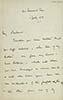
Thanks him for his letter and for his explanation of his Utopia. [see 94/109]. Regrets that his 'difficulties' have not been removed by Sidgwick, but claims that the subject is 'far too wide to be discussed within the limits of any correspondence', and suggests that he may trouble Sidgwick 'at some future time with a question or two' when he has given due consideration to the passages to which Sidgwick referred him. Claims to be 'wholly unable to understand what [motives] in [Sidgwick's] ideal community would supply the place of those on which [are now defined] for the Conduct of industrial enterprise.' Refers to Commodore [Vanderbilt], who was responsible for supplying bread to 1000 people in New York 'for the very small remuneration of $200.000.000.' Doubts whether [any] government 'could get its work done so cheap.' Asks how the capital of the world is to keep pace with the population if neither the government nor anyone else is allowed to make any profit. Refers to the fact that private enterprise would have to be prohibited, and that a 'gigantic monopoly' would be in place, which would probably be corrupt and inefficient. Believes that this [line] of progress is 'extremely dangerous' and that 'those who encourage the poorer classes to look for salvation in this direction incure an enormous responsibility'. Understands however that, according to the current German and English economists, the trend is heading in Sidgwick's direction. Cannot agree that 'the [ ] countries of Europe loaded with debt and standing armies and with a constant pressure of pop[ulatio]n on the soil, are at the same stage of industrial and social development as the U[nited] States, Canada and Australia. Refers to the principles of free exchange.

Letter from Charles Hughes Terrot
Add. MS a/213/110 · Pièce · 25 Oct. [1844?]
Fait partie de Additional Manuscripts a

For some years they have been 'employed in getting up a school or college in Scotland for the education of the young of our church, and also for training candidates for orders'. They want to start next year with a Sub-Warden: 'The election rests with the six Bishops of the Scotch Episcopal Church. Now I suppose there must be in Cambridge many men quite qualified for all I have mentioned'. However 'the difficulty lies in the strong conflict of opinions prevailing among us, as among you in England' regarding Tractarians and Puritans: 'I am very desirous of having a Cambridge rather than an Oxford man' because this problem is less embedded at Cambridge, and secondly because they want someone with a knowledge of science as well as Greek and Latin. He must be in Priests orders and should not be under 30.

Letter from Henry Holland
Add. MS a/206/110 · Pièce · 14 Nov. [1860]
Fait partie de Additional Manuscripts a

Brook Street - Thanks WW for a copy of his Platonic Dialogues - 'you have succeeded in seizing their exact spirit'. He hopes WW will be encouraged to go on with the work.

Letter from Charles Lyell
Add. MS a/208/110 · Pièce · 20 Feb. 1831
Fait partie de Additional Manuscripts a

2 Raymond Buildings, Gray's Inn - CL has nearly overcome his difficulties in nomenclature: 'Your arguments for curtailing the superfluous vowels satisfy me, and the threat of the future reviewer is most agreeable'. CL thinks 'Paracene and Procene tho' pretty words ought not to be used as comprehensive grouping names, for there would then be confusion between the greater and the subordinate Cenes. Your Cenogenous is infinitely better than my Cenophorous, especially for a reason which must always be kept in view in chronological names in geology, that it may with propriety be affixed to each of the separate tertiary beds, rocks etc and their contents - now I should not wonder if the terminology which we are now constructing should ultimately prevail over every other hitherto invented'. CL proceeds to talk about the terminology coined by the French geologist, Alexandre Brongniart. CL gives his definitions of the geological divisions - Hypogene, Paleogene, Cenogene and Contemporary.

Richard Jones to William Whewell
Add. MS c/52/110 · Pièce · [10 Oct. 1846?]
Fait partie de Additional Manuscripts c

Due to RJ's state of health it would 'be prudent to change my day till Saturday' [to come up to Cambridge]. RJ has heard that George Peacock is seriously ill at Wiesbaden in Germany. 'Louis Philippe has surely dug the grave of his dynasty it has become our interest and that of Europe to prevent the union of France and Spain by driving the Orleans people from one or both thrones and with a little patience we may have our choice of which he shall forfeit if he keeps either. They have no root at all in France and less than none in Spain - it is unpleasant to part with the dream of there being one wise old man among the principalities and powers of this world'.