
BACH/D/9/11
·
File
·
1970-84
Part of Papers of G. K. Batchelor
3351 results with digital objects
Show results with digital objects
BACH/H/11
·
File
·
1952
Part of Papers of G. K. Batchelor
BENS/A/11
·
Item
·
1889
Part of Papers of Edward White Benson
MYER/11
·
Series
·
1848-1900
Part of Myers Papers
BACH/A/4/11
·
File
·
1952-53
Part of Papers of G. K. Batchelor
SMIH/4/11
·
Item
·
[n.d.]
Part of Papers of Sir Henry Babington Smith
Formally entitled 'The Bishop and the Bogey'.
MAYR/B/11
·
File
·
1838-1898
Part of Mayor Papers
GOW/A/2/4/11
·
Item
·
[n.d.]
Part of Papers of A. S. F. Gow
GREG/1/11
·
Item
·
11 Feb. 1930
Part of Papers of Sir Walter Greg (W. W. Greg)
The Hythe Croft, Eynsham, Oxon.—Draws attention to a reference to a portrait of Edward Alleyn’s father or father-in-law.
—————
Transcript
The Hythe Croft, Eynsham, Oxon.
11. Feb. 1930
Dear Greg,
The life of Alleyn (by Oldys) in Biographia Britannica (1744-66) i. 115 mentions a picture at Dulwich, long thought to be his father, but stated to Oldys to be his father-in-law by one Thomas Waterhouse. The picture gave the age as 59.
Did you ever look into this? If father-in-law is right, I should think that it was more likely Henslowe than Woodward.
Yrs ever
E. K. Chambers.
GOW/C/2/11
·
Item
·
5 Aug 1944
Part of Papers of A. S. F. Gow
Dunmore, By Tarbert, Argyll. - 'Thank you so much for... your memoir of Gaselee'.
GOW/E/7/11
·
Item
·
13 Dec 1960
Part of Papers of A. S. F. Gow
The Old Granary, Startfield Saye, Reading, Berks. - Greek textual commentary.
Add. MS a/53/11
·
Item
·
4 Nov. 1843
Part of Additional Manuscripts a
Add. MS c/106/11
·
Item
·
18 May 1906
Part of Additional Manuscripts c
Add. MS c/89/11
·
Item
·
9 Oct. 1855
Part of Additional Manuscripts c
Add. MS c/90/11
·
Item
·
10 May 1842
Part of Additional Manuscripts c
Add. MS c/98/11
·
Part
·
29 July 1886
Part of Additional Manuscripts c
Promises to do his best to give Dr Frefort 'the latest academic ideas' if Patterson sends him to Sidgwick with an introduction. Warns that, being in the vacation, he will have to take his chance of finding people there. States that he does not know any else here whom Patterson knows, except Sedley Taylor. Suggests that, through Bryce, he might find out who there is at Oxford to help him. (2 docs)
Add. MS c/66/11
·
Item
·
5 May [18--]
Part of Additional Manuscripts c
Add. MS c/80/11
·
Item
·
13 Oct. 1890
Part of Additional Manuscripts c
Add. MS c/218/11
·
Item
·
19 Oct. 1905
Part of Additional Manuscripts c
Add. MS c/95/11
·
Item
·
2 Dec. 1868
Part of Additional Manuscripts c
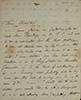
Claims that he was about to write to Sidgwick in relation to Gardiner's volumes of the Morning Watch. Gives the address to which to send them if he is finished with them. Thinks he may be able to be in London 'about the 5th', and proposes that Sidgwick return with him, and stay as long as he can. Announces that he must go to Bath for a few days, and would do so when Sidgwick goes to Clifton. Declares that his time will be almost entirely his own in London, and he shall be staying with [Samuel?] Gardiner close to [ ] [ ] and Martineau's. Confides in Sidgwick that he has had a very heavy financial loss, which might cause him to give up his visit to London. Hopes that he may not have to change his plans, except by taking on extra pupils, 'and writing a little harder' for the following few months. Claims that unless he can go to London 'cheerfully', he should not be much good as a free Christian. Declares that they must 'try and [ ] Payne on the Pall Mall [Gazette?], which is getting sadly reactionary.' Also informs him that he has 'a very singular spirit, ghost, or dream, story' for Sidgwick when they meet.
Add. MS a/207/11
·
Item
·
28 Nov. 1824
Part of Additional Manuscripts a
2 Orchard St., Portman Sq. - WW's paper on Crystallography was read at the Royal Society and an abstract will be distributed at the next meeting ['A General Method of Calculating the Angles Made by Any Planes of Crystals, and the Laws According to which They are Formed', Phil. Trans., 1825]. JH did not hear whether WW had made any reference to Levy's paper in Brewster's journal. Because of the similarity with his paper, WW should refer to it in his abstract.
Add. MS a/355/4/11
·
Item
·
15 Nov. 1927
Part of Additional Manuscripts a
Bodleian Library, Oxford.—Discusses arrangements for supplying an American doctor with a copy of the Proceedings of the Oxford Bibliographical Society, and congratulates McKerrow on his Introduction to Bibliography.
(With an envelope.)
—————
Transcript
Bodleian Library | Oxford {1}
15 Nov. 1927
O.B.S.
Dear Dr. McKerrow,
Every member of the O.B.S. has the right to purchase one extra copy of each part of Proceedings. I could treat the application of the Chicago Medical Book Company, therefore, as coming from you and supply the American M.D. with a copy of Pt. 3 {2}. But of course, you might wish to purchase a second copy yourself. What shall we do?
Yours sincerely
S. Gibson
P.S. I should like to add that I heartily congratulate you as the author of An Introduction to Bibliography. We are all deeply indebted to you.
[Direction on envelope:] Dr. R. B. McKerrow | Enderley | Gt. Missenden | (Bucks)
—————
The envelope was postmarked at Oxford at 1o p.m. on 15 November 1927.
{1} The first part of the printed address, ‘Stone Bank, Hill Top Road’, has been struck through.
{2} i.e. Part III of the second volume.
Add. MS c/58/11
·
Item
·
10 Feb. 1891
Part of Additional Manuscripts c
bei Peters, Jaeger Strasse 67, Berlin - [Georg] Berkholz has been dead for two years and his work is in the hands of Heinrich Diederichs; [Wilhelm] Mannhardt's MS is probably there as well; will send a copy of [Eadwine's Canterbury] Psalter.
Add. MS c/60/11
·
Item
·
24 July 1911
Part of Additional Manuscripts c
Bank House, 95 High Street, Lewisham, S.E. Private - Calls Frazer's attention to the difference in English Civil Law concerning marriage between a stepmother and stepson and the same relationship if the woman had not married the father.
Add. MS a/678/11
·
Item
·
[18th cent.?]
Part of Additional Manuscripts a
Copied out, as if for instruction or punishment. In unidentified hands.
Add. MS a/681/11
·
Item
·
3 May 1936
Part of Additional Manuscripts a
(Brown’s article is headed, ‘A. E. Housman. “The Shropshire Lad”’.)
Add. MS b/71/11
·
Item
·
10 Jul 1901
Part of Additional Manuscripts b
Thanks her for sending back the letters from Henry Sidgwick. Undertakes to see if he can find any more from him, but doesn't think there are many, if any. Hopes that his uncle Arthur Sidgwick will cut back on some of his other work, of which he believes he does 'far too much', in order to devote himself to the writing of the memoir. Declares that '[t]he great desideration is that the writer should want to [write] more than anything else in the world - and everything is quickly and well done when that is behind.' Advises Nora to ask Maggie if she can find any letters, and states that there are a good many papers at [ ]. Undertakes to look there when he goes back there in August.
Benson, Arthur Christopher (1862-1925), poet and college head
Add. MS b/74/11/11
·
Item
·
12 Jan. 1875
Part of Additional Manuscripts b
Public Record Office.—Has informed the Queen’s printers (Eyre & Spottiswoode) of the inconvenience to which Aldis Wright would be put by their mode of printing, and encloses their answer.
—————
Transcript
Public Record Office
12th Jany 1875
My dear Mr Aldis Wright
I wrote to the Queen’s Printers on the subject of the inconvenience to which you would be put, by their mode of printing, and I enclose their answer {1} so I hope every thing will proceed according to your desire
Yours very truly
T. Duffus Hardy
——————
{1} Add. MS b. 74/11/12.
Add. MS b/74/14/11
·
Item
·
30 Mar. 1885
Part of Additional Manuscripts b
(Cambridge.)—Discusses the relation of ‘sceaðen’, which seems to be a hapax legomenon, to words in Middle English and Icelandic.
(Undated. Postmarked at Cambridge on 30 Mar. 1885.)
—————
Transcript
Sceaðen seems to be a hapax legomenon. As a fact, the A.S. sceaða [masc. = one who harms] took the secondary sense of “harm” when it passed into the M.E. skathe, because it became identical with M.E. skathe [= Icel. skaþi, masc. = harm, damage]. See Stratmann, p. 437: Layamon, 25691.—Strictly, Icel. skaþi = A.S. sceðð, by umlaut of a to e. Bosworth gives sceðð, but no reference.
W. W. Skeat.
[Direction:] W. Aldis Wright Esqre | Trinity College | Cambridge [At the foot:] Local.
—————
Postmarked at Cambridge on 30 March 1885.
Add. MS c/31/11
·
Item
·
2 Sept. 1906
Part of Additional Manuscripts c