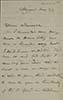
The British Institute, Paris - Sends his subscription to the bibliography.
4 Carlton Gardens, Pall Mall, S.W.1. - Thanks him for the promised present of 'The Gorgon's Head'. Accompanied by the envelope.
British Legation, Berne - Had thought of calling on them, but thought Sir James' health would not allow this, hopes to meet her presently, and will go see the exhibition of Sir James' work.
One complete typescript draft, corrected, of the French translation of the preface, with four copies of the first two pages.
Woodside, Cove, Dumbartonshire - Has received official word that Baldwin Spencer died of angina pectoris; will let him know about his notes when she hears more, thanks Frazer for offering to place his letters from Baldwin at their disposal, wonders if there is a book in them.
Accompanied by the envelope.
Daily Record, Evening News, Sunday Mail, 67 Hope Street, Glasgow, C.2. - Did not introduce himself as they were surrounded; has paid tribute to Sir James and featured his speech [on being given the Freedom of Glasgow].
Welcombe, Stratford on Avon. - Good to hear that Julian is settled in his own nursery again; sure he remembers it 'as he notices so much'. Very glad that nurse [Mrs Catt] is really better, and hopes all will go well now. She and Sir George are settling down at Welcombe; they are alone till George and Janet come on Wednesday. Sir George says Elizabeth 'must not mind about paying'. Sends love to Bob, and says she 'will read the Medici letters [edited by Janet Ross] with much interest'. She and Sir George did not like the Post impressionists [the exhibition organised by Roger Fry at the Grafton Galleries] which 'leave the impression of a bad, & rather nasty dream, though [she] can see how clever some of it is'.
Hyderabad Deccan. - Cannot say how grateful he is to Trevelyan for enabling Andrusha [Andrew Kalitinsky] to get through his school. India, and the Indians, feel very strange to him, and he misses Europe very much; there is so much careerism at Calcutta and politics does not 'seem to touch the lives of people', while elsewhere 'the Fascist methods of the Govt. of India have cast a gloom on things'. He decided to sacrifice his individual happiness to save his friends from 'never-ending worry' by taking up permanent work in India, but there seems nothing to be had. Lacks influential support: his father has retired and knew few people; his uncles want to make names for themselves. Wishes he might find something at the League [of Nations] but the 'axe' is in operation there too. Asks if [Clifford] Allen might mention him to some people at Geneva; sends congratulations to him [on his peerage] and is glad he will play a role in public life again. Hyderabad is 'romantic' and he likes it better than any other Indian town, but it is getting hot and he finds it difficult to breathe. Is trying to get an interview with Sir A. Hydar, 'the Dictator of the place' [Osman Ali Khan, Asaf Jah VII?] but has not yet succeeded. His book on Islamic art in Spain is doing well here; will give a few lectures on modern English poetry and European literature, for which he is being paid badly. Will go to Delhi and try there for the Leaue. Sends love to Bessie and Julian.
Mount Park, Harrow-on-the-Hill. - Thanks Trevelyan for his 'delightful present' ["The New Parsifal"?]; has just begun to read it and is finding it 'promising'; the printing is 'beautiful'.
They are both [he and Georgie] wearing their 'flannel shirts now', which are 'very comfortable. The parson preached 'a Conservative speech about disestablishment (rather out of place where it was)', and they 'all laughed about it afterwards' since he 'kept calling the party for disestablishment robbers'. They had their paper-chase last Wednesday, but it rained [portion of text obscured by tape here]. Supposes everything will be taken to Grosvenor Crescent from Ennismore Gardens if the latter is to be let, and that it will be all right to send letters there. Does not think he needs 'anything particular'. Adds a postscript saying they are now reading Cicero and Horace; likes Cicero, though it is 'rather hard'.
Thorpeness, Suffolk. - Robert's poems ["From the Shiffolds"] were a 'delightful surprise': it is a great 'comfort... to turn away from the utterly beastly war to poetry, or music or the like'. The world is 'nearly intolerable' and the war 'seems quite interminable'; hopes it has not treated Robert 'too cruelly' and that he has not had too many doodlebugs. They [she and her friend Lady Dorothea Gibb] were 'on their route for many nights', and the guns against them 'made a devil of a row', but it has been more peaceful recently; she sees however that the death toll from the doodlebugs was 'dreadfully high' last month. Is glad Roger [her brother] is not here to 'endure it'. 'Poor Holland must be suffering terribly': expects the Trevelyans are 'longing for news', as she is herself of 'one dear friend there'. Sends some of her 'own products', though quite different to Robert's; he need not read or acknowledge them. Her anthology, "Ruth's Gleanings", is 'obstinately out of print like most books'. Hopes next year will bring 'a happier world in every sort of way'.
Wimbledon House, 36 Sussex Square, Brighton - May Cornford engaged, 26 pound bill for rooms this term, including his mother's stay.
Arrived at Stapleton
Is touring Rhodes and the Peloponnese with Jim [Mossman?]; will probably see him in June.
Written from Downing College Lodge.
Asks her to forward his letters at once to the Marine College, Essex. Explains that they have been sent to Rugby, because he has 'a servant who thinks for himself...' States that he has been at his present address since the previous Wednesday. Thinks that he must give up the idea of going to Rugby. Explains that he has many visits to pay in July, and that, until his fever subsides he dreads railway travelling. Asks her to write and tell him about what she and the others are going to do in the holidays, and when she intends to leave Rugby. Promises that he shall try to come, 'at least for a night or two, before that.'
Thanks Nora for the reviews of Henry Sidgwick: A Memoir, which he returns to her [not included]. Agrees that the people who did not know Henry or his work are the people who disapprove of the book. Adds that they could not accommodate everybody. Also returns [letters from] J.B. Mayor, 'O[scar] B[rowning]' and Lady Rayleigh [not included]. Lists the publications from which he has reviews of the book, and undertakes to send Nora any that she has not got. Has already given away five copies of the book, and has 'not quite finished yet'.
Sidgwick, Arthur (1840–1920), educationist and classical scholarRefers to their conversation about the teaching of law in the schools at Oxford, which he believes is not in a very satisfactory state. Discusses the required reading when he was examining - Stephens's Blackstone - as compared with the reading required today. Doubts that it is possible to 'make the school work satisfactorily as regards law', things being the way they are. Gives three reasons for this situation: the narrowness of the field examined; the insufficiency of the teaching; the lack of a suitable textbook. Refers to the relevance of the history of law. Laments the almost total lack of instruction in English Law in Oxford, and the unsatisfactory character of the examination. As regards international law, he does not think it to be a satisfactory subject, for two reasons: knowledge of Roman Law is required; a knowledge of modern European history is required. States the need for teachers and books, such as those by Austin and Bentham, and claims that Maine's Ancient law can be understood 'by any one of average intelligence'.
Digby, Sir Kenelm Edward (1836-1916) Knight, lawyerStates that he shall be very proud to talk to Sidgwick's 'Society'. Tells him to fix any time that suits him. Says that he has not got a subject, but expects to be able to come up with something. Announces that he will be in Cambridge soon, and hopes that he will see Sidgwick then.
Stephen, Sir Leslie (1832-1904), knight, author and literary criticExplains that he had postponed writing to Sidgwick until he returned to the India Office in order 'to be able to review the state of official business', and that he had come to London the previous day. Refers to the fact that between his election to 'the [Whewell] Professorship and the present time', he had not resigned his membership of the India Council, and had 'prepared and delivered a course of lectures on International Law.' Explains that his intention was 'to prevent any inconvenience to the Secretary of State.' Announces that the India Office now require his further assistance or services, and that there is one piece of business involving the proposed reorganisation of the Public Service in India, his withdrawal from which 'might certainly embarrass the Secretary of State seriously.' Refers to the government of India, and to the 'educated Natives' of the country, who take an interest in politics, and more specifically, 'in the system by which public employment is distributed.' States that he was involved in the formation of a powerful Commission to investigate the subject, and that he has had much correspondence unofficially with some of the Commissioners 'and latterly with Lord [Dufferin].' Explains that the Commissioners are now preparing their report, which will shortly be before the India Office.
Asks Sidgwick his opinion on the wisdom of he [Maine] asking Sidgwick to mention to those involved [in appointing Maine to the Professorship] that he proposed to retain his seat in Council, until the above questions are disposed of. Owns to be taken aback by the opinions which Sidgwick has reported to him. Announces that he returns to Cambridge that night, and that before leaving he wrote to the Master of Trinity [Henry Montagu Butler], explaining to him why he had not as yet acted further on his advice.

Thanks WW for his book ['Of the Plurality of Worlds: An Essay', 1854]: 'I have read it with deep feeling - and if I may use the liberty of saying so must profess to believe that it is a book which cannot fail greatly to modify generally received opinions, even if it should not lead to the adoption of a belief altogether differing from that which has prevailed in modern times'.
Clifton, Bristol - JDF is disappointed that 'on the very eve of quitting the north [to avoid the weather] I learned by your kind note that we might have hoped to see you today'. Mr and Mrs Airy have been to stay for a couple of days. Since he has been ill, JDF has been struck by the sympathy he has received from his Cambridge friends.
Richards's Coffee house, Temple Bar - Thanks WW for his letter which contains many excellent schemes. EB has been with Babbage and Herschel: 'we have had a kind of committee of notation' and 'have agreed also upon a Digest, of which you must take part. It consists of a collection of all known algebraic results, arranged in the order of Deduction'.
Collingwood - JH has not been working much on his translation of Homer's 'Iliad'. He will not be attending the BAAS meeting in October: 'that sort of thing is more than I can face now'. De Morgan has sent him a spoof of the opening of book one of the 'Iliad' [JH encloses a copy].